8 Best B2B Ecommerce Platforms in 2025 (Features, Pros & Cons)
As buying habits shift toward online self-service, B2B companies need a platform built for complex pricing, bulk orders, multi-user accounts, and more.
So, this article will walk you through core platform features and a review of leading B2B ecommerce platforms in 2025. The goal is simple: help you understand what fits your business model and expectations. Whether you want something easy to maintain or something powerful enough for global operations, you’ll find clear direction here.
What is a B2B ecommerce platform?
In simple terms, a B2B eCommerce platform is software that enables businesses to sell products or services to other businesses via an online storefront. Unlike a basic website, a true B2B eCommerce system supports complex workflows: custom pricing, CRM automation, bulk purchases, and quote-based transactions.
Why does this matter so much now? The answer is digital transformation. For B2B companies, digital channels are no longer a “nice-to-have” — they are essential. According to market projections, by the end of 2025, 80 percent of B2B sales interactions will occur online.
We are in the midst of a digital procurement revolution. As clients increasingly demand the transparency, speed, and convenience they experience in B2C environments, businesses must adapt, or risk being left behind.
Core features of a top B2B ecommerce platform
If you’re evaluating which B2B platform to adopt, consider these five features based on your business goals. Let’s see how they transform B2B commerce experience, and why they matter:
1. Custom & Tiered pricing (Contract pricing)
In B2B you rarely have one fixed price for everyone. Companies negotiate contracts, set volume discounts, or get highly customized quotes. A platform must support:
- Different price lists per customer or customer segment
- Volume-based tiers (e.g., lower unit cost after 1,000 units)
- Contract-based pricing tied to negotiated terms
This flexibility ensures your platform reflects real business deals rather than a one-size-fits-all list price.
2. Request-for-Quote (RFQ) and Negotiation tools
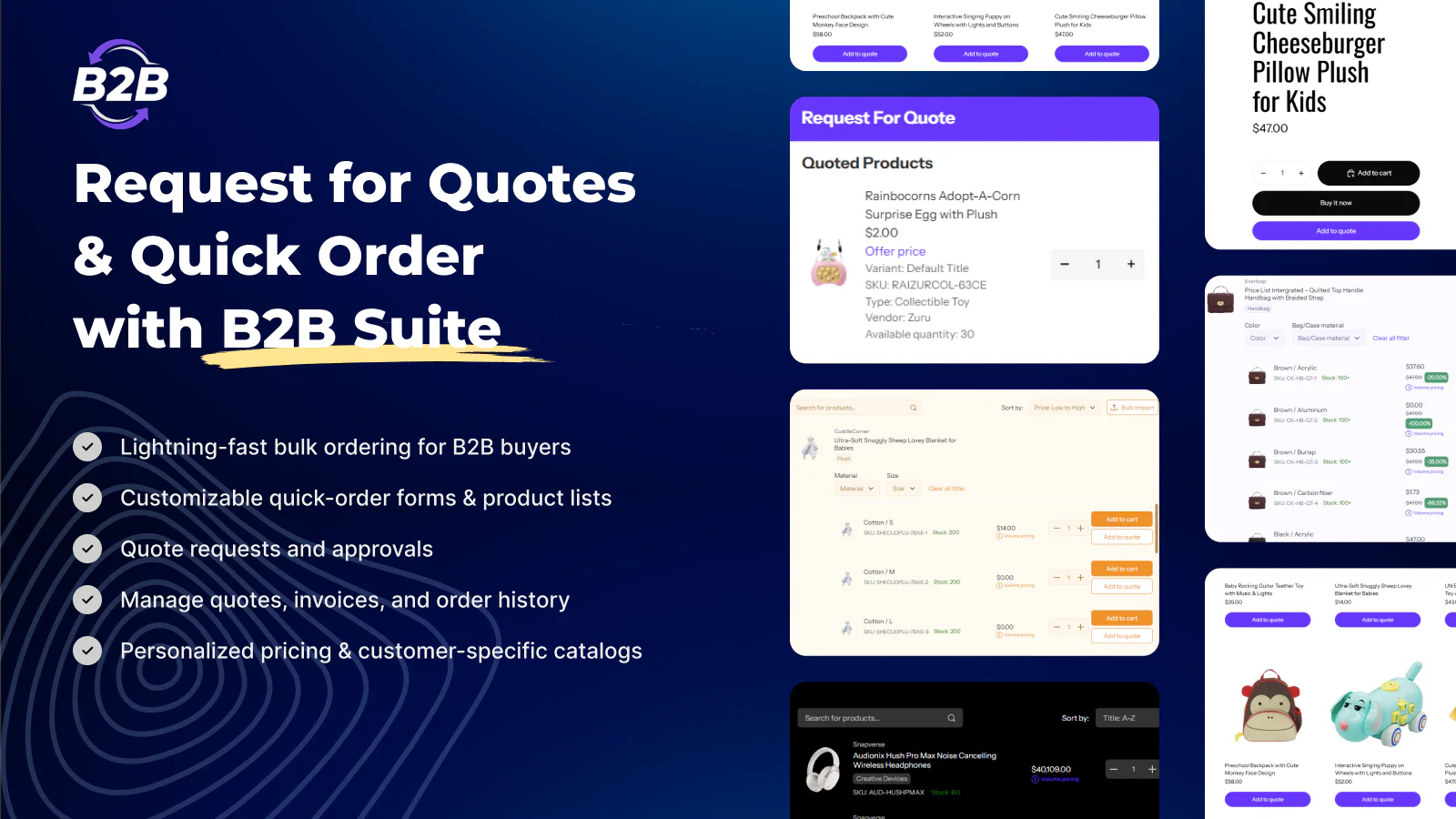
Many B2B orders begin not with a shopping cart, but a quote request. A good platform supports RFQ workflows, letting buyers submit proposals, negotiate, and submit final orders.
Without this, you force high-value customers back into email or phone-based sales cycles, defeating the purpose of digital commerce.
3. Account-based access & Multi-user controls
In B2B, purchasing is often a team sport. You might have multiple buyers under one company account — each with different roles (approver, requester, finance). A capable platform offers:
- Hierarchical account structure
- Role-based permissions (who can request, who can approve)
- Shared company catalog access
This feature mimics how real companies buy: collaboratively and with checks & balances.
4. Seamless ERP & CRM Integrations
One of the biggest challenges in B2B is keeping back-office systems in sync. If your storefront is not tightly integrated with ERP (Enterprise Resource Planning) or CRM (Customer Relationship Management), you are likely to run into price mismatches, incorrect inventory, and manual reconciliation work.
A modern B2B platform must support real-time or near-real-time API-based syncing so pricing, inventory, and customer data stay accurate.
5. Self-Service Buyer Portal
Today’s B2B buyers often expect to serve themselves rather than involving a sales rep for every order. A self-service portal gives customers:
- Order history and reordering capabilities
- Invoice access and payment tracking
- Quote status and negotiation tools
This reduces friction, frees your sales team for strategic tasks, and gives buyers the autonomy they increasingly demand.
Best B2B ecommerce platforms in 2025
Here are some of the best ecommerce platforms for b2b today, along with who they are best for, their strengths, and limitations:
- Shopify Plus
- BigCommerce
- Salesforce Commerce Cloud
- Adobe Commerce (Magento)
- WooCommerce for B2B
- OroCommerce
- Kibo Commerce
- SAP Commerce Cloud
Shopify Plus
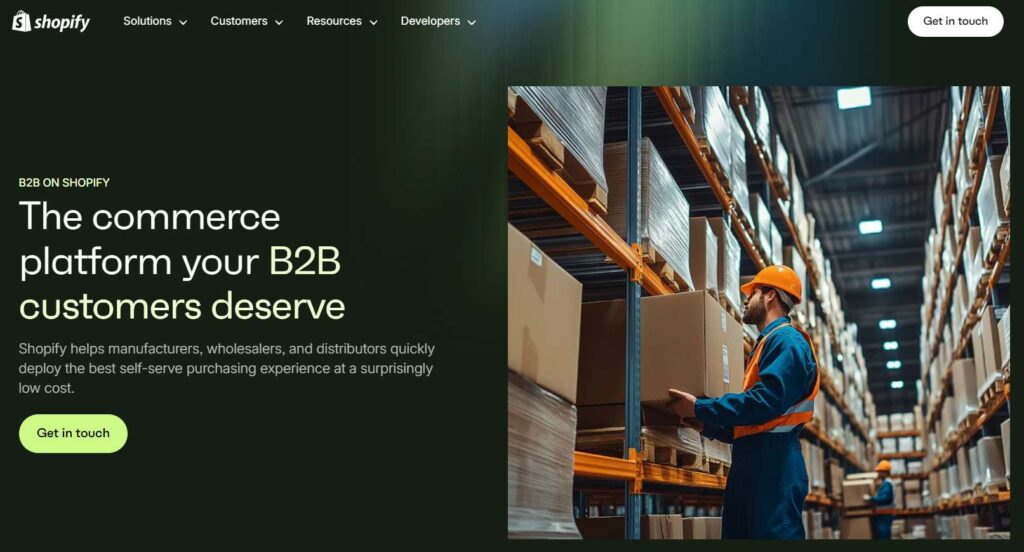
| Best for | Businesses that want a fast, stable, low-maintenance B2B launch, especially if you run both B2C and B2B. |
| Key features | Company profiles, Custom catalogs & pricing, Quantity rules, Self-serve buyer portal |
Shopify Plus is the considered the most polished, reliable option for B2B sellers who want growth without tech headaches. I like how fast you can launch a fully working storefront, even if your team has limited development resources. Shopify provides an impressive ecosystem of third-party integrations and B2B apps, which make unifying your business operations and data much easier.
On the other hand, if you don’t want to deal with plugins, Shopify can be overwhelming.
Pros:
- Very user-friendly interface, great for teams without heavy technical support
- Strong app ecosystem; many B2B apps extend functionality
- Customizable analytic dashboard with B2B ecommerce KPIs and metrics
- Excellent reliability and performance at scale
Cons:
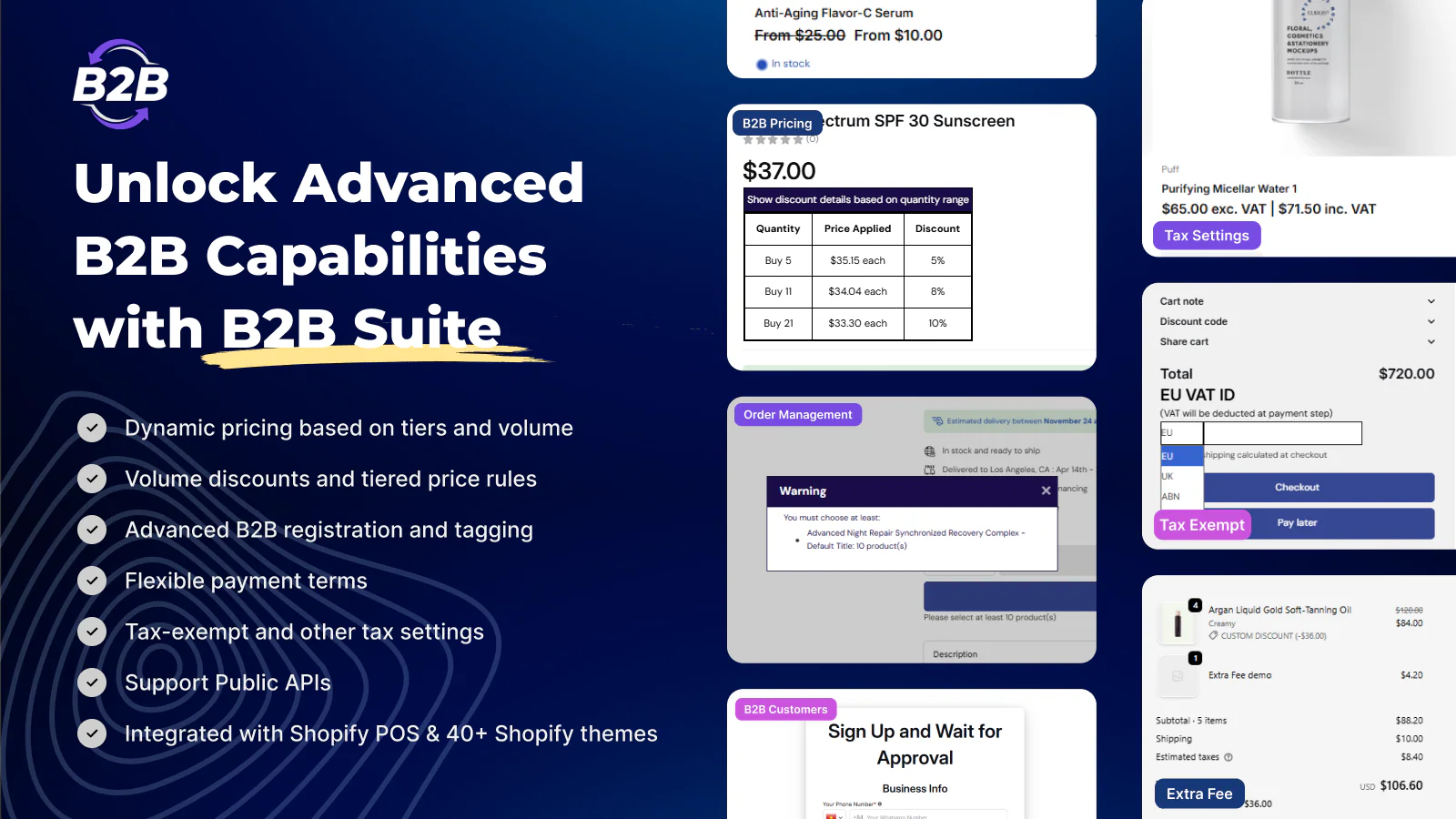
- Some advanced capabilities (e.g., RFQ or complex contract pricing) require plugins
- Can be pricey for enterprise-level B2B, especially with additional third-party apps
Note: You can run a B2B Business on Shopify without the Plus plan. There are a number of Shopify B2B solutions that you can install and get essential B2B features for your store.
BigCommerce
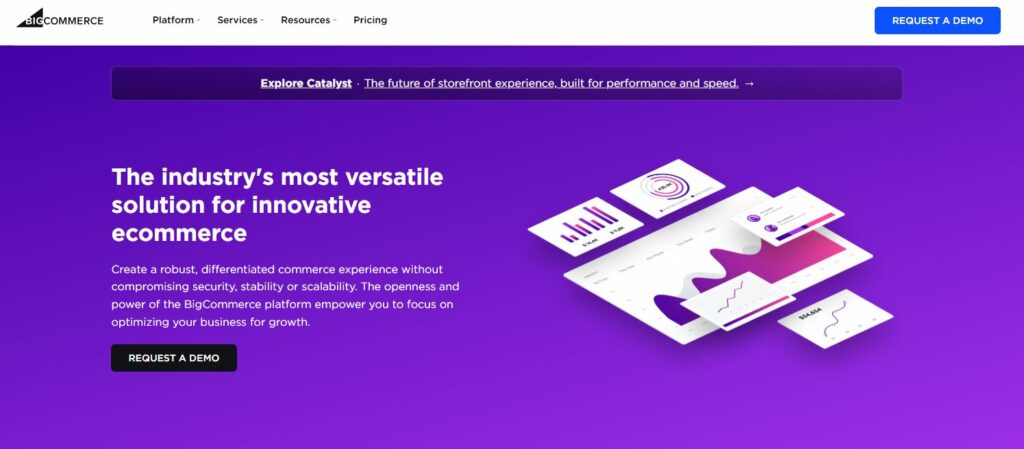
| Best for | Medium-to-large B2B businesses |
| Key features | Configure-Price-Quote (CPQ), Multi-company hierarchy, Customer groups, Buyer portal & reordering |
BigCommerce B2B Edition is a SaaS platform built specifically with B2B needs in mind. It offers many native features like tiered pricing, customer groups, and multi-user accounts without needing heavy customization. Its core strength is offering ready-to-use B2B tools in a scalable, hosted solution.
Some organizations may find that useful, while those that need very specialized workflows still require technical work or third-party integrations. BigCommerce works well for wholesalers and distributors who want strong functionality without building a system from scratch.
Pros:
- Built-in B2B features like customer groups, custom pricing, and multi-user accounts
- Flexible API and headless support
- Good performance and SEO capability
Cons:
- Customization may require more development work compared to open-source
- Pricing can grow steep with scale and heavy customization
Salesforce Commerce Cloud
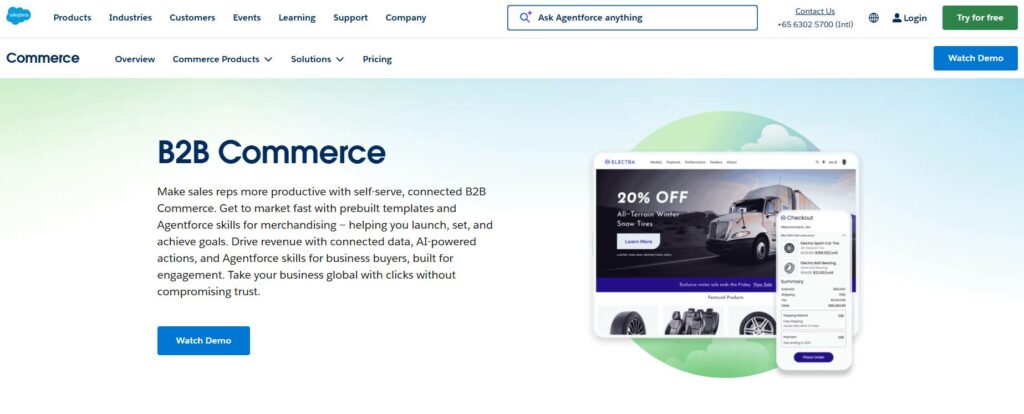
| Best for | Enterprises with a large volume, complex account management, and especially planning to use Salesforce CRM |
| Key features | Account-based pricing, Quote-to-order conversion, Headless commerce APIs, Order orchestration |
Salesforce Commerce Cloud for B2B is part of the Salesforce ecosystem, built for companies that want deep CRM integration with their online sales. In my experience, the level of automation and personalization it allows is unmatched. The trade-off is cost and complexity: you’ll need technical resources and planning to get the most out of it.
Pros:
- Deep integration with Salesforce CR
- Flexible and highly configurable
- Powerful automation and AI-driven personalization
- Supports global enterprises effectively
Cons:
- High cost and steep learning curve
- Overkill for smaller B2B companies with simple needs
Adobe Commerce (Magento)
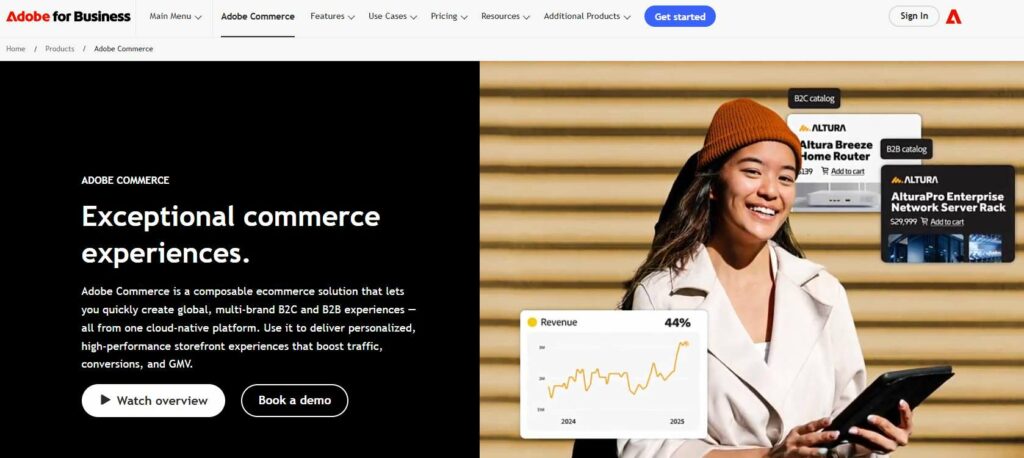
| Best for | Businesses needing full control over customization, B2B complexity, and scale |
| Key features | Company accounts & roles, Negotiable quotes (RFQ), Shared catalogs & custom pricing, Requisition lists |
Adobe Commerce is an open-source platform known for its flexibility and extensive B2B capabilities. It allows you full control: you can tailor nearly every aspect of the B2B workflow to match business requirements.
The challenge is ongoing maintenance and the need for skilled developers to manage hosting, updates, and security. Overall, Adobe Commerce suits businesses with unique B2B processes that cannot be met by standard SaaS solutions.
Pros:
- Very mature B2B module (contract pricing, custom catalogs)
- Highly customizable for complex workflows
- Open-source options for developers
- Strong community support
Cons:
- High technical requirements for maintenance and updates
- Higher total cost of ownership (TCO) when self-hosted
>> You may concern: How to Start a Wholesale Business in 2025 (Step-by-step)
WooCommerce for B2B
| Best for | Small-to-medium businesses already using WordPress or looking for a cost-effective B2B entry point. |
| Key features | Custom pricing levels, Role-based accounts, Net terms and invoicing, Bulk ordering, SKU entry |
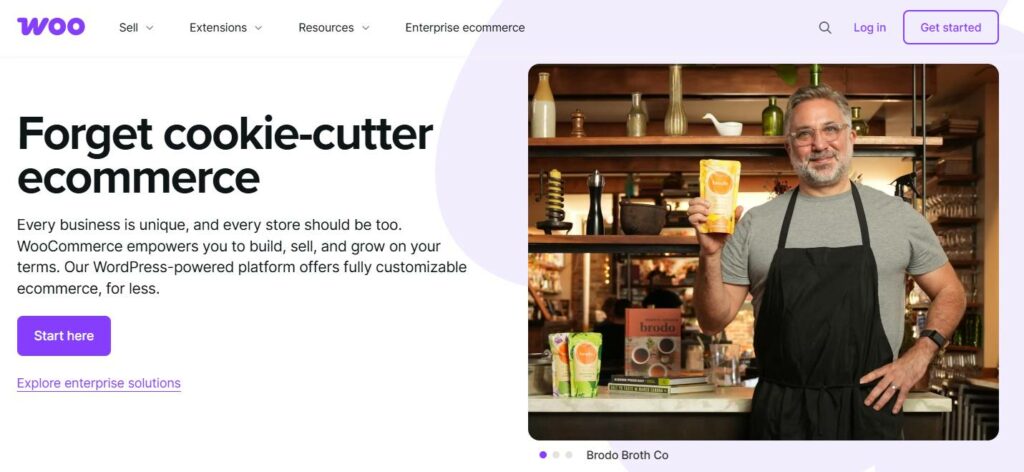
You probably know WordPress – the most popular platform for blogging. Then WooCommerce is a flexible, cost-effective way to run B2B commerce inside WordPress. It works especially well if you are comfortable with using WordPress, only have a small team, and want to launch a store without spending much upfront.
As its nature, you will need to use plugins for B2B functions and further customization. This means the quality of these add-ons matters and can greatly affect your business.
Pros:
- Very easy to use if you are already familiar with WordPress
- A wide range of B2B extensions (for quoting, pricing, accounts)
- Flexible and relatively low cost for small catalog size
Cons:
- Extensions may not integrate seamlessly; quality varies
- Scaling to more complex B2B operations can be challenging
- Security, performance, and maintenance depend heavily on hosting setup
OroCommerce
| Best for | High-volume, B2B-focused businesses |
| Key features | RFQ / Quote management, Multi-organization accounts, Custom pricing & catalogs, Role-based permissions |
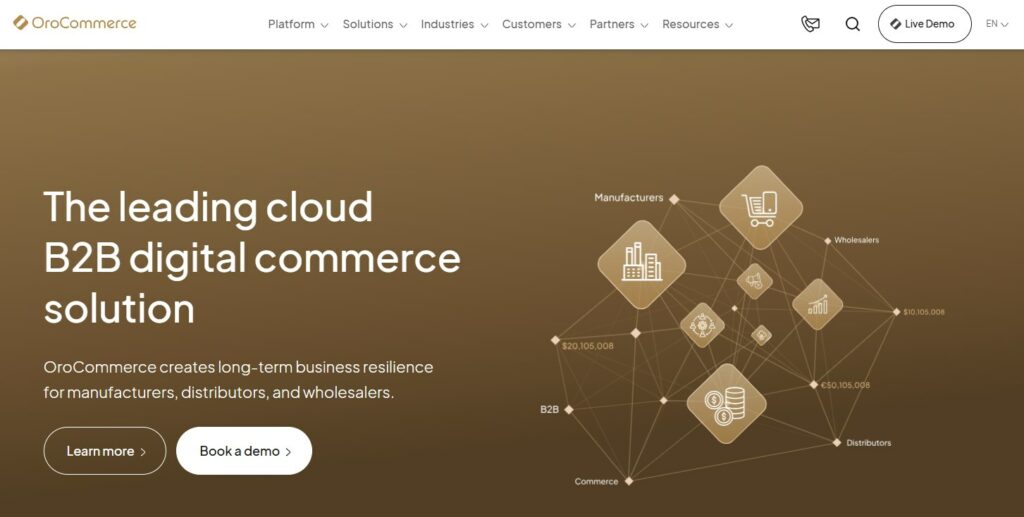
OroCommerce is designed specifically for B2B operations. It excels in complex workflows like RFQs, multi-organization accounts, and custom pricing.
Its main strength is the platform’s B2B-first architecture, which handles enterprise requirements out of the box. While the enterprise-grade capabilities are impressive, teams without technical support may need guidance to fully leverage the system.
Pros:
- Designed specifically for B2B from the ground up
- Built-in RFQ, custom pricing, multi-organization accounts
- Open source (community edition) plus enterprise version with advanced support
Cons:
- Less out-of-the-box polish compared to bigger SaaS platforms
- Requires developer expertise for customization
- Smaller ecosystem of plugins compared to mainstream platforms
Kibo Commerce
| Best for | Enterprises that need a unified commerce environment across B2B, B2C, and direct-to-consumer (D2C) channels |
| Key features | Headless API, Omnichannel order orchestration, Personalized pricing & catalogs, Quote management |
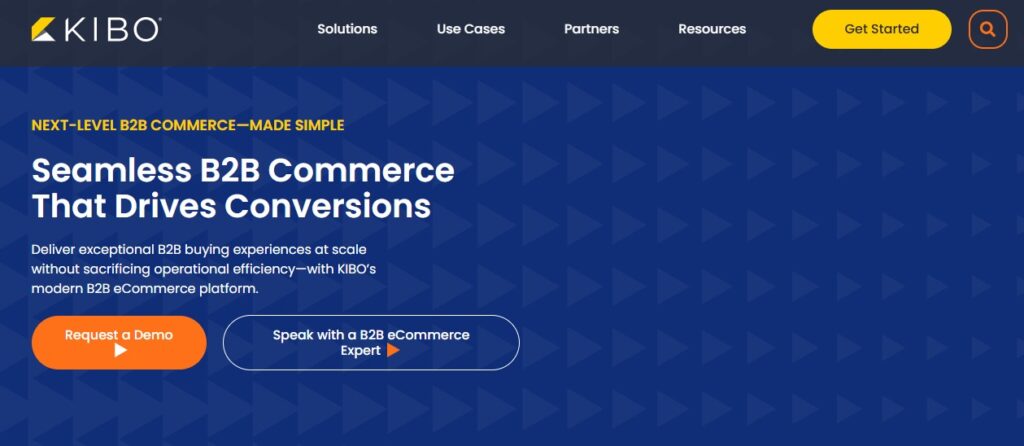
Kibo Commerce focuses on unified commerce for B2B, B2C, and marketplaces. Its API-first, headless architecture gives flexibility to create tailored experiences across channels. I find its personalization and omnichannel features quite nice, but complexity can be challenging for smaller teams. If you want a modern, multi-channel experience, Kibo is worth considering.
Pros:
- Headless commerce support
- Strong API layer, mobile-first capabilities
- Powerful personalization, promotions, and order orchestration
Cons:
- Higher cost of entry
- Requires a skilled technical team
- May be more than needed for B2B-only companies
SAP Commerce Cloud
| Best for | Large global enterprises, manufacturers, distributors with complex, high-volume B2B operations |
| Key features | Contract & quote management, Multi-site & multi-catalog support, Account hierarchies, ERP integration |
SAP Commerce Cloud excels at enterprise-scale B2B operations, particularly if you use SAP ERP. Its real-time pricing, contract management, and inventory synchronization are unmatched for large distributors. That said, implementation is lengthy and expensive, so it’s most suitable for organizations with large budgets and complex workflows. For global enterprises, SAP Commerce is a powerhouse.
Pros:
- Extremely robust: supports complex pricing, quotes, contracts, global catalogs
- Deep integration with SAP ERP systems
- Highly scalable and reliable for international operations
Cons:
- Very expensive and resource-intensive to deploy
- Requires skilled SAP commerce and ERP consultants
Examples of Successful B2B Websites
Heinz (Shopify Plus)
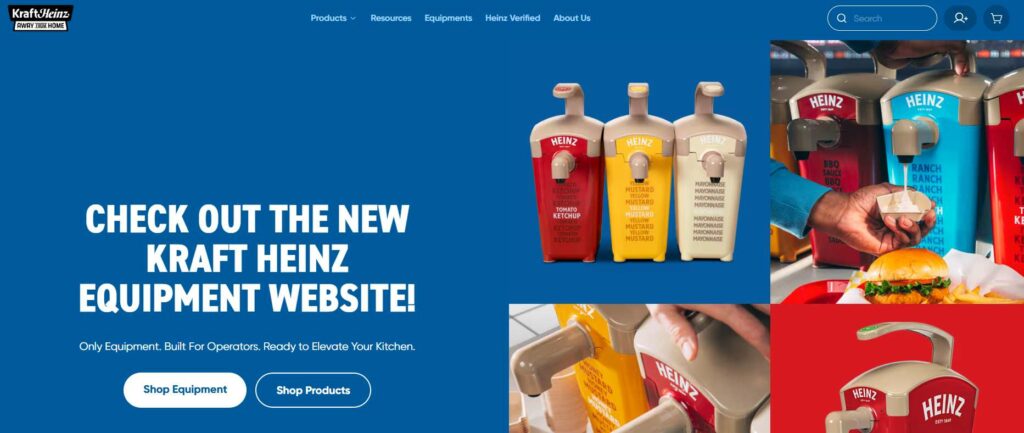
Heinz expanded its wholesale and bulk-order operations using Shopify Plus, giving foodservice partners and retailers a cleaner, more self-service way to place orders.
Many food brands struggle with outdated wholesale portals, but Heinz avoids that by using Shopify’s flexible storefront tools and B2B features. Retailers and partners get straightforward order flows, while Heinz’ internal team manages catalogs and pricing without heavy technical work.
You can also check out more successful Shopify Plus stores.
GE Appliances (BigCommerce B2B Edition)
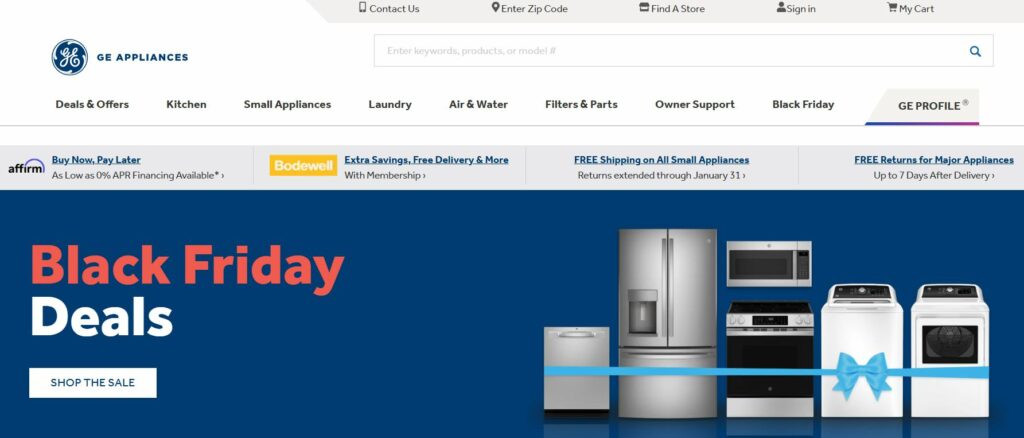
GE Appliances built its commercial site on BigCommerce to support dealers, contractors, and property managers who need fast ordering and clear product data. For a brand that manages thousands of SKUs across multiple categories, those native B2B tools make daily operations smoother. BigCommerce’s open API structure also lets GE plug into its existing back-end systems without slowing teams down.
JCB (Adobe Commerce / Magento)
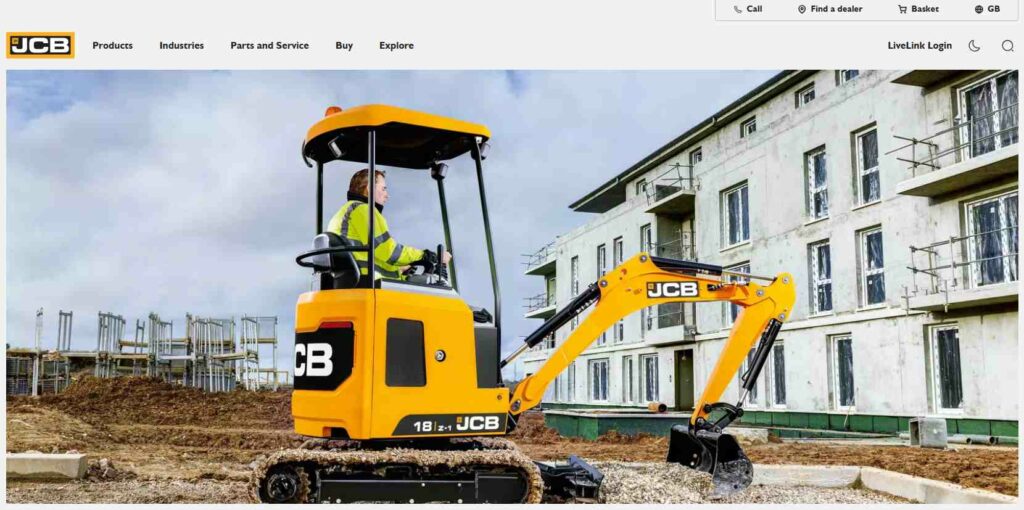
JCB, one of the world’s largest construction equipment manufacturers, uses Adobe Commerce to power a dealer-first B2B portal. Dealers often need precise parts ordering, technical documentation, and account-based access. Adobe Commerce gives JCB the flexibility to build deep customizations around parts compatibility, bulk ordering, and role-based account permissions.
How to choose a B2B ecommerce platform
Choosing a B2B ecommerce platform becomes much easier when you break the decision into a few practical steps. I’ve helped teams evaluate platforms for years, and these factors consistently determine whether a platform supports long-term growth or becomes a barrier.
- Map your operational needs before comparing platforms
Every strong B2B store depends on clear processes. Before you look at features or pricing, outline how your business handles catalogs, pricing, orders, customer accounts, and back-office work. When you know how your team operates, you will instantly see which platforms support your workflows and which require heavy customization. This step saves time, cost, and future rework.
- Prioritize integration requirements early
B2B operations often rely on ERP systems, CRMs, PIMs, and inventory management tools. Make a list of systems your business must connect to. Some platforms offer native connectors for common omnichannel tools like Shopify Plus and Salesforce. Others require custom development. Knowing your integration requirements helps you avoid platforms that look good on the surface but cannot support your tech stack.
- Evaluate pricing structures with long-term scale in mind
B2B companies often handle large order volumes, multiple storefronts, and complex catalogs. Look at pricing beyond the initial subscription. Factor in costs for apps, development, hosting, bandwidth, and support. A platform that feels affordable now might become expensive when your wholesale orders grow. I usually advise teams to project 2–3 years ahead to understand total cost of ownership.
- Assess customization needs and internal skill level
Some B2B companies want a platform that runs smoothly with minimal technical effort. Others need deep flexibility to support custom workflows, quoting processes, contract pricing, or multi-entity structures. Ask yourself how much control you want and how much development capacity your team can realistically manage. This helps you choose between a user-friendly SaaS platform or a more customizable, developer-heavy option.
- Look for scalability and performance features
B2B buyers expect fast load times, accurate stock visibility, and smooth checkout experiences. Choose platforms that support caching, API scalability, multi-store setups, and global deployments if needed. Strong scalability ensures your store can handle seasonal surges or high-volume buyers without slowing down. This becomes even more important as B2B buyers shift toward mobile and on-the-go procurement.
FAQs about B2B ecommerce platforms
What makes B2B eCommerce different from B2C?
B2B buying often involves negotiations, contracts, multiple decision-makers, and larger volumes. Unlike B2C, where checkout may take seconds, B2B often needs quoting, approvals, and custom pricing.
How much does a typical B2B eCommerce platform cost?
It varies widely. For example, Shopify Plus + B2B extension setup for a small business can cost from $2,300/month, while complex enterprise platforms (like SAP Commerce or Salesforce) can run into the hundreds of thousands, once you include development, integrations, and maintenance.
Which platform is best for a hybrid B2B/B2C business?
Platforms like Shopify Plus, Kibo Commerce, or Adobe Commerce work very well. They support both B2C storefronts and B2B portals, enabling one unified commerce strategy.
Final Thoughts
As a B2B business owner or decision-maker, your choice of eCommerce platform will shape your customer experience, operational efficiency, and long-term growth. The right platform empowers buyers with self-service tools, aligns with your back-office systems, supports complex pricing, and scales with your ambitions.
Start by mapping your workflows, evaluating your future needs, and running a pilot. That way, when you invest in a platform, you’re not just choosing software, you’re choosing a partner in growth.

Finn Nguyen
Finn is a Shopify expert with 5+ years of experience helping new business owners launch and grow online stores. Specializing in store setup, theme selection, and optimization, he provides practical guidance to turn ideas into successful eCommerce businesses