Is Shopify B2B or B2C? Run Both in One Store (2026)

Shopify supports both B2B and B2C. One store can sell to consumers and to businesses, which Shopify calls a blended store. Since April 2, 2026, Shopify’s native B2B features, including company profiles, up to three custom catalogs and payment terms, are included on Basic, Grow and Advanced. Plus keeps full access.
Last updated October 9, 2026. Shopify facts below come from Shopify pages read on October 9, 2026. BSS B2B Solutions makes BSS B2B Solution, Lock and Quote, which appear where an app fills a gap. For the full B2B picture, read the complete Shopify B2B guide.
Key takeaways
- A Shopify store can serve B2B and B2C buyers at once. Shopify’s term for this is a blended store; a separate store only for businesses is a dedicated store (Shopify: B2B store types).
- A blended store cannot be gated to B2B customers only, because D2C customers could not place orders. A dedicated store can be gated.
- Native B2B is included on Basic, Grow and Advanced from April 2, 2026, with up to three custom catalogs. Direct catalog assignment to companies, deposits and partial payments stay on Plus (Shopify announcement).
- The hard part of a hybrid store is keeping each audience out of the other’s prices and products, not the platform itself.
Is Shopify B2B or B2C?
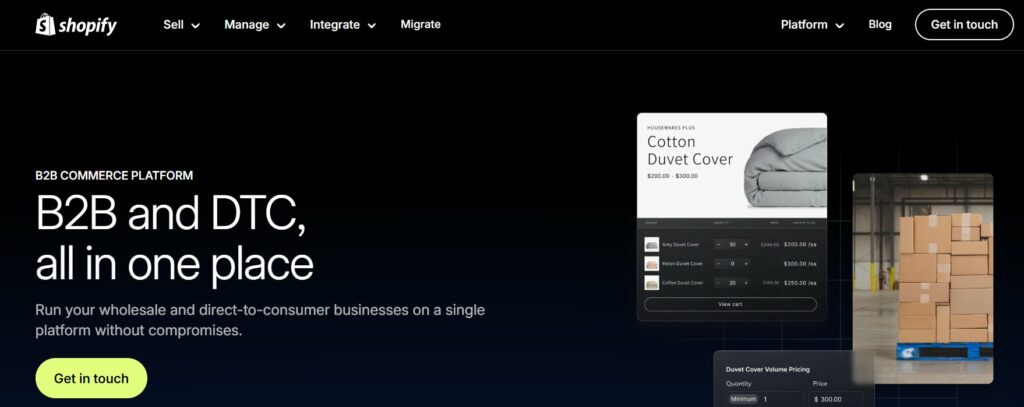
Both. Shopify’s B2B help page says you can use one store for both B2B and direct-to-consumer (D2C) sales, or create a separate store just for B2B (Shopify B2B overview). Business buyers are set up as companies in the Shopify admin, and each company can have its own pricing, currency, products, payment and shipping methods.
Blended store or dedicated store?
| Blended store | Dedicated store | |
|---|---|---|
| What it is | A single Shopify store used for both B2B and D2C customers | A separate Shopify store used only for B2B customers |
| Gate the whole store to B2B buyers | No. D2C customers could not place orders | Yes. The URL and login page can be limited to B2B customers |
| Best when | Retail and wholesale share products, brand and stock | Wholesale needs a different look, rules or audience |
Shopify’s setup checklists cover each type (blended store checklist). Our blended store glossary entry has the short definition.
What changed on April 2, 2026
On April 2, 2026, Shopify said it was extending its foundational B2B features to Basic, Grow and Advanced “at no extra cost”. Those merchants can use company profiles for wholesale buyers, up to three custom catalogs and payment terms without changing plans. Plus continues to offer full access, including unlimited catalogs, direct catalog assignment, partial payments and deposits (Shopify: B2B for more merchants).
Before then, stores on lower plans needed an app for wholesale pricing and access. That still applies when you need more than three custom catalogs. Our native B2B guide and B2B without Plus guide compare the two routes.
B2B buyers vs B2C shoppers
| Area | B2B buyers | B2C shoppers |
|---|---|---|
| Who buys | Businesses, retailers, distributors | Individual shoppers |
| Order size | Bulk, case or pallet | Small, often single units |
| Pricing | Tiered, negotiated or customer-specific prices | Standard retail prices |
| Payment | Net terms, invoices, purchase orders | Cards, PayPal, wallets |
| Checkout | Quotes, PO numbers, restricted access | Guest checkout and fast checkout |
| Tax | VAT exemptions, resale certificates | Standard consumer tax |
This is why a hybrid store needs deliberate setup: the same product page has to serve two kinds of buyer.
What a hybrid Shopify store needs
Separate prices for each audience
Shopify catalogs determine the pricing and products your B2B customers have access to. Each company location can have its own tax ID, tax exemptions, addresses, pricing and payment terms (Shopify blended store checklist). Native B2B allows up to three custom catalogs on Basic, Grow and Advanced. If you need more groups, tag-based pricing from an app covers it. See the wholesale pricing hub.
Wholesale access that retail shoppers do not see
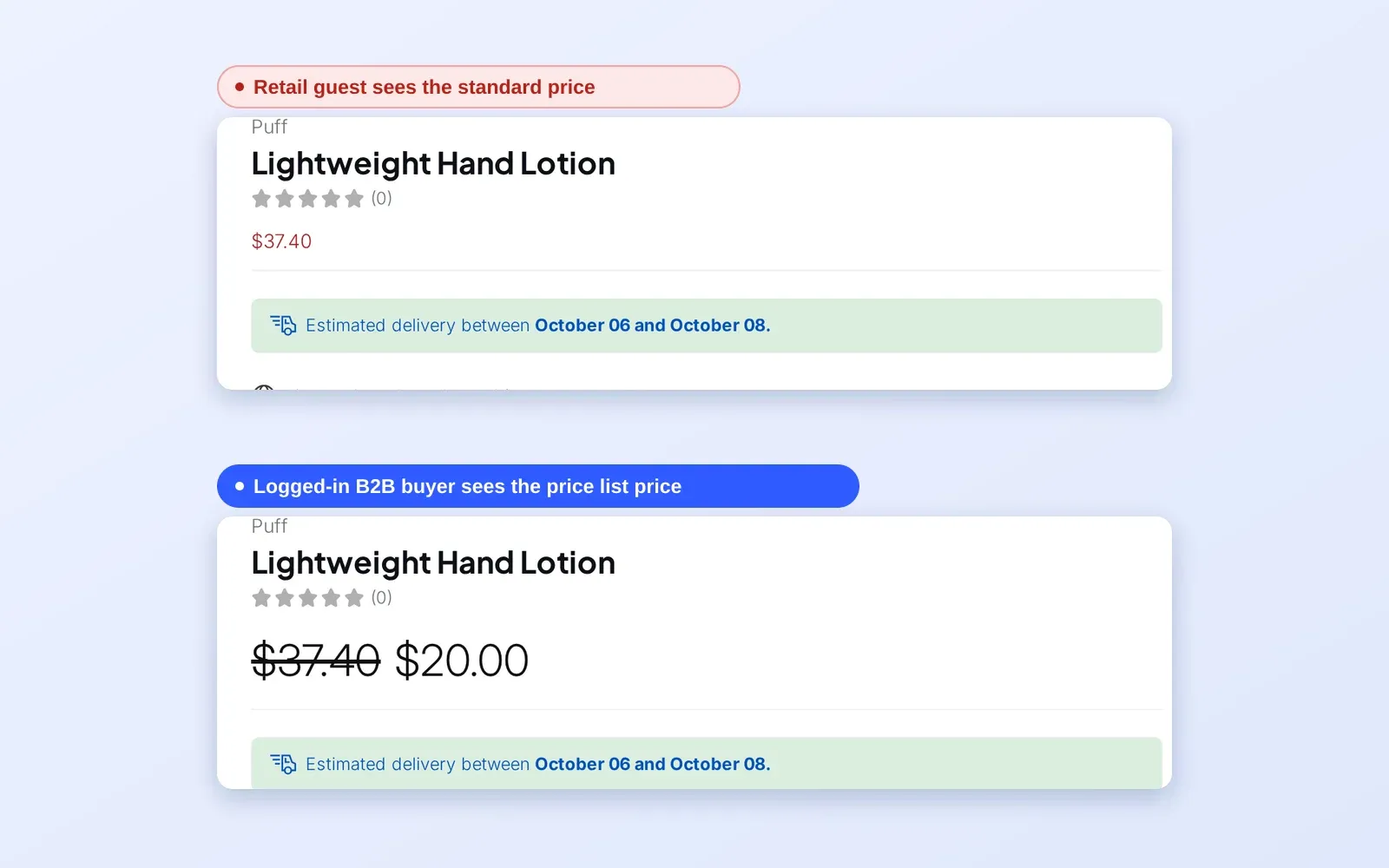
Shopify’s blended checklist includes the step “Hide products from D2C customers that are only available to B2B customers” and points to apps for extra workflows. Common setups hide wholesale collections behind a customer tag or hide prices from guests. Read hide collections by customer tag, show retail price, hide wholesale price and the access control hub.
A way for wholesale buyers to apply
Tags are the simplest way to separate customer types without building a second site: wholesale, distributor or a VIP-B2B tag decides what a buyer sees. A registration form with approval assigns the tag for you. See the B2B registration form guide.
Terms and tax that match business buying
Business orders often need net terms, purchase order numbers and tax exemptions, while retail orders use standard card payments and consumer tax. Shopify supports payment terms and tax exemptions per company location. For tax handling by buyer type, see the tax compliance hub.
How BSS customers run B2B and B2C in one store
Two published BSS case studies describe a hybrid store. Results are the merchants’ own reports and not a forecast for your store.
- Schlechte Karten runs retail and wholesale in one store on the Shopify Basic plan. BSS B2B Solution adds a registration form with approval, custom pricing and tax display for business buyers.
- Best Buddy sells pet snacks to consumers and retailers in one Shopify store. It uses BSS B2B Solution for pricing rules, quantity increments, order limits and a registration flow with auto-tagging.
Custom pricing by customer tag, volume pricing, registration forms with approval and auto-tagging, tax display, order limits and net terms. Free on development stores, 14-day trial on paid plans.
Install BSS B2B Solution See pricingTo lock wholesale prices or pages for guests, add BSS B2B Lock. To compare apps first, read the best Shopify B2B apps.
Common problems in a hybrid store
| Problem | What goes wrong | What to do |
|---|---|---|
| Price conflicts | A retail discount and a wholesale price apply to the same variant | Keep one rule per audience and test with a retail and a wholesale account |
| Access mistakes | Wholesale prices show to guests, or a B2B catalog is hidden from buyers | Audit tags, company assignments and collection rules each month |
| Mixed tax handling | Tax-exempt B2B orders sit next to taxable retail orders | Store each buyer’s tax ID and exemption, and test an exempt order end to end |
| Shared stock | Retail and wholesale draw from the same inventory | Decide in advance which audience gets priority and how you will track it |
Frequently asked questions
Is Shopify a B2B or B2C platform?
Both. Shopify’s help center says one store can be used for B2B and D2C sales, or you can create a separate store only for B2B. Native B2B features are included on Basic, Grow, Advanced and Plus.
Can one Shopify store run B2B and B2C?
Yes. Shopify calls it a blended store. Products and pricing for B2B customers are customized with catalogs assigned to B2B markets.
Do I need Shopify Plus to sell B2B and B2C together?
No. Since April 2, 2026, native B2B is included on Basic, Grow and Advanced, with up to three custom catalogs. Plus adds unlimited catalogs, direct catalog assignment, partial payments and deposits.
Can I limit my store to B2B customers only?
On a dedicated B2B store, yes. A blended store cannot be gated to B2B customers only, because D2C customers could not place orders. In a blended store you lock wholesale pages, collections or prices instead.
Is it better to use one store or two?
One store shares products, brand and stock. Two stores separate the audiences and need two sets of settings. Choose by how different the two audiences are.
Sources
- Shopify: B2B features for more merchants (April 2, 2026), read October 9, 2026.
- Shopify Help Center: B2B overview, read October 9, 2026.
- Shopify Help Center: blended and dedicated B2B stores, read October 9, 2026.
- Shopify Help Center: blended store checklist, read October 9, 2026.
- BSS case studies: Schlechte Karten and Best Buddy.
You may also like

Shopify Tiered Pricing: How to Set Up Quantity Tiers for Wholesale and Retail (2026)
Shopify tiered pricing means the unit price drops as the quantity grows. Native Shopify B2B supports it […]

11 Shopify B2B Examples: Real B2B Websites and Case Studies (2026)
The best Shopify B2B examples do one job clearly: a gated application, customer-specific prices, quick reordering or […]

8 Best B2B Ecommerce Platforms in 2026 (Features, Pros & Cons)
The best B2B ecommerce platforms in 2026 are Shopify (fastest launch, native B2B on every plan), BigCommerce […]