


heyimsakina is a UK independent illustration studio selling art prints, greeting cards and stationery. Alongside the retail shop, shop owners can apply as stockists through a short form, then order under published wholesale terms. The pack and minimum rules behind the order flow run on BSS B2B Solution.
About heyimsakina
heyimsakina (heyimsakina.com) sells uplifting art and stationery from an illustrator’s studio in the United Kingdom. The shop is built around hand-drawn, brightly coloured illustrations of people, fruit and everyday moments, printed as greeting cards, art prints, gift wraps, notebooks and a yearly calendar. The shop header carries the illustrator’s wordmark, the navigation is short, and the opening banner shows prints against a wall of bananas.
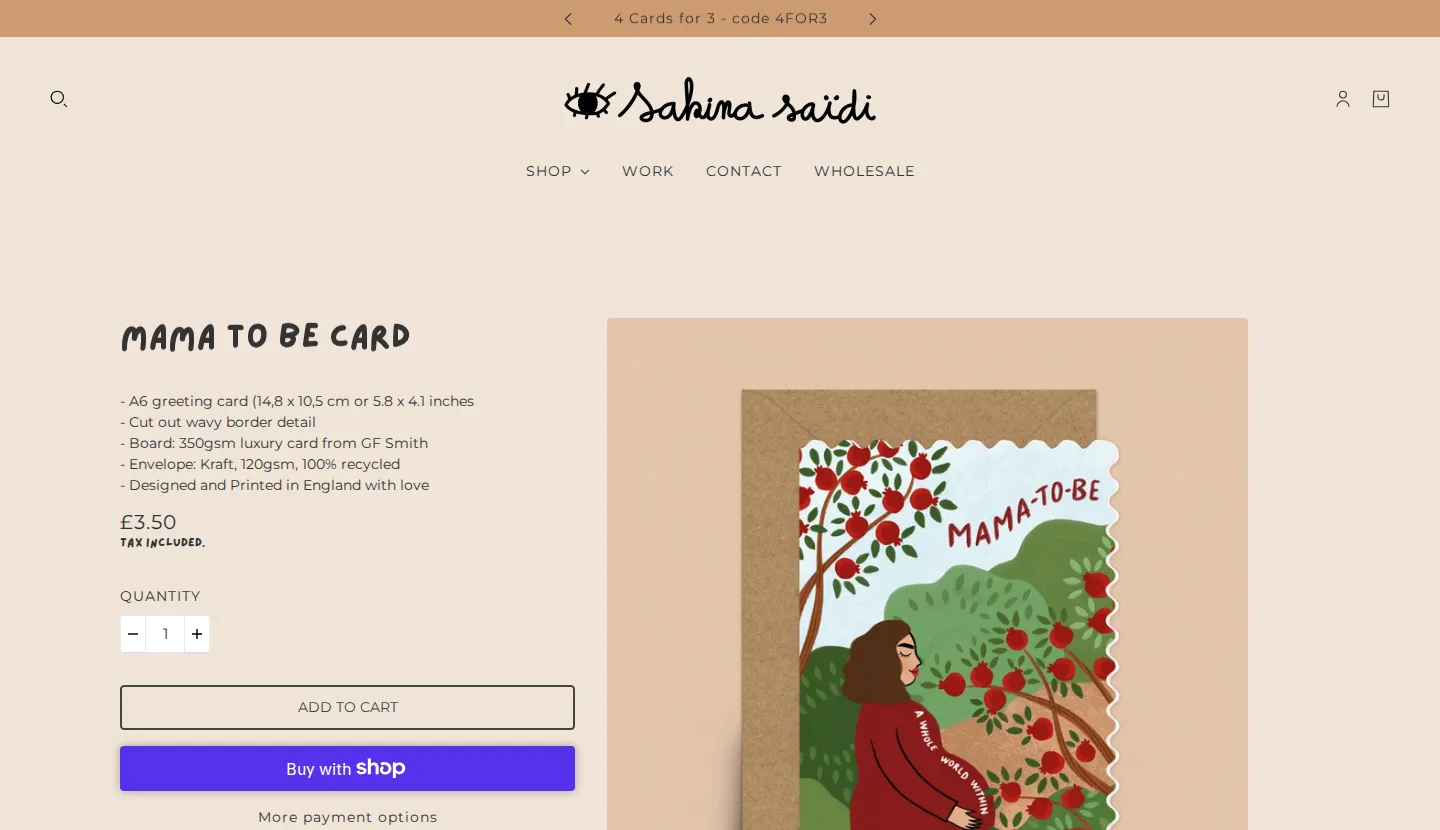
Product pages describe the materials plainly. A greeting card is an A6 card with a wavy cut-out border, made from 350gsm luxury card, with a kraft envelope of 100 percent recycled paper, designed and printed in England. Cards sell at a few pounds each at retail. A pack of cards is exactly the kind of product that independent gift shops, bookshops and cafes stock, and that is where the wholesale program comes in.
The business is a small one. The site is written in the first person and shipping rates are listed in short plain sentences. That matters for this story, because a small brand has one scarce resource: the owner’s time. Every wholesale feature the shop uses is a way to answer a question before it becomes an email.
The B2B model: retail shop plus a stockist program
heyimsakina is a hybrid store. Consumers buy cards and prints from the main shop. Independent shops apply to become stockists. The menu has a Wholesale link that leads to a landing page inviting shop owners to apply. A separate stockists page lists four product categories (cards, prints, gift wraps and notebooks) and has a Proudly stocked in section.
The invitation is short. It says the studio’s work is stocked in independent shops across the UK, the EU and the USA, and asks interested shop owners to get in touch. Under the form sit four badges that tell a buyer what kind of supplier they are dealing with: independent artist, printed in the UK, socially conscious and eco friendly. For a gift shop owner who cares about provenance, those four words are part of the sales pitch.
How the storefront handles wholesale
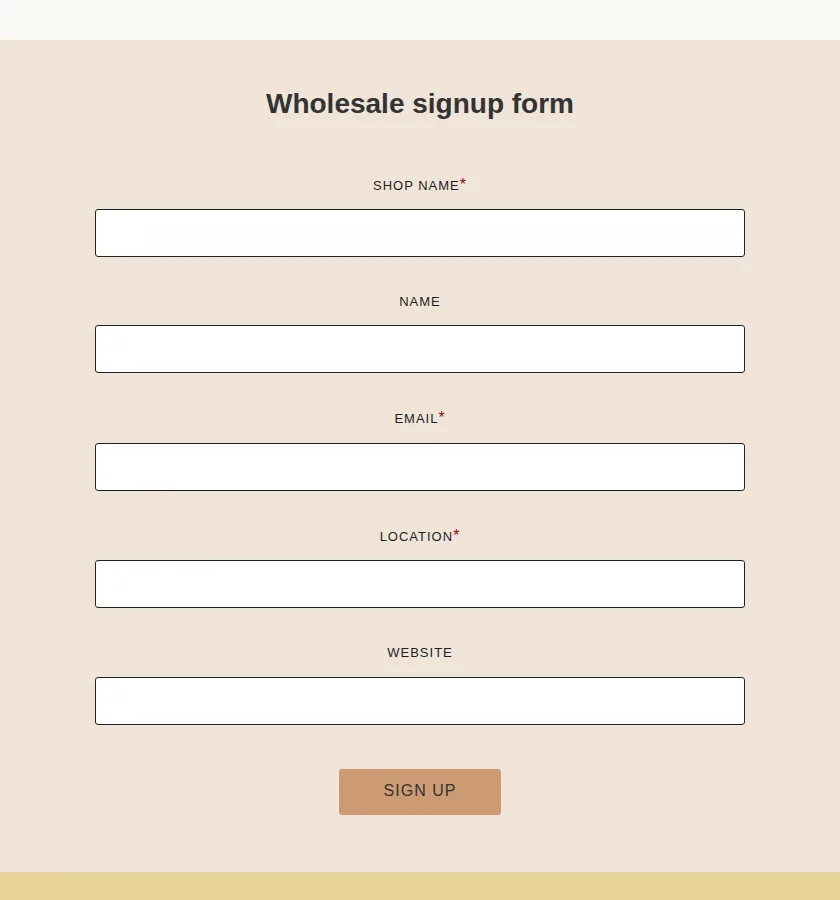
A five-field stockist form
The application form is small: shop name (required), name, email (required), location (required) and website. There is no tax ID, no document upload and no long questionnaire. A short form like this lets a small brand collect the essentials and check the shop’s website itself, instead of asking a gift shop to fill in a long form.
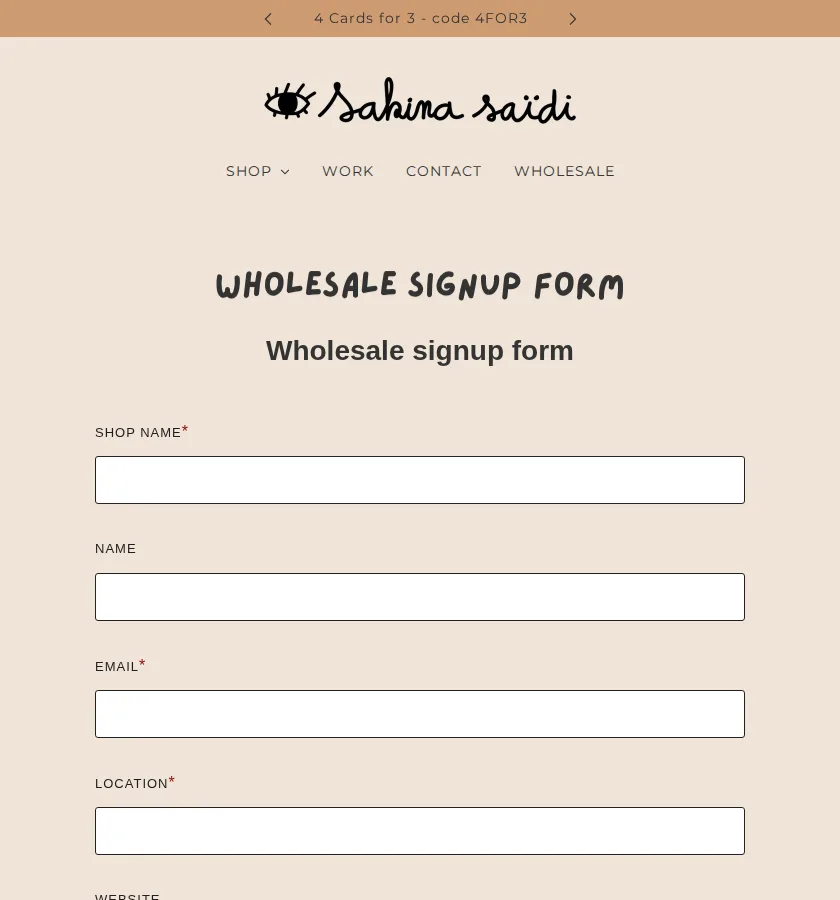
The form is a BSS B2B Solution registration form, and the production configuration shows it is active and assigns a customer tag when an application is approved. The tag is the switch that turns a visitor into a stockist in the rest of the store. The form can grow with the business: the same editor supports longer forms, tax ID fields and conditional logic when the brand needs them.
Terms published before the first order
The wholesale terms page is a short block of plain text. It states a minimum order of 85 pounds, a delivery charge for the UK mainland and free delivery above 250 pounds, a note that shipping outside the UK mainland is quoted by email, a lead time (packed and dispatched in one to three days, longer at busy times or for large orders) and a cancellation rule: all orders are firm sale unless goods are faulty or damaged, and a mistake must be reported within 48 hours of receipt.
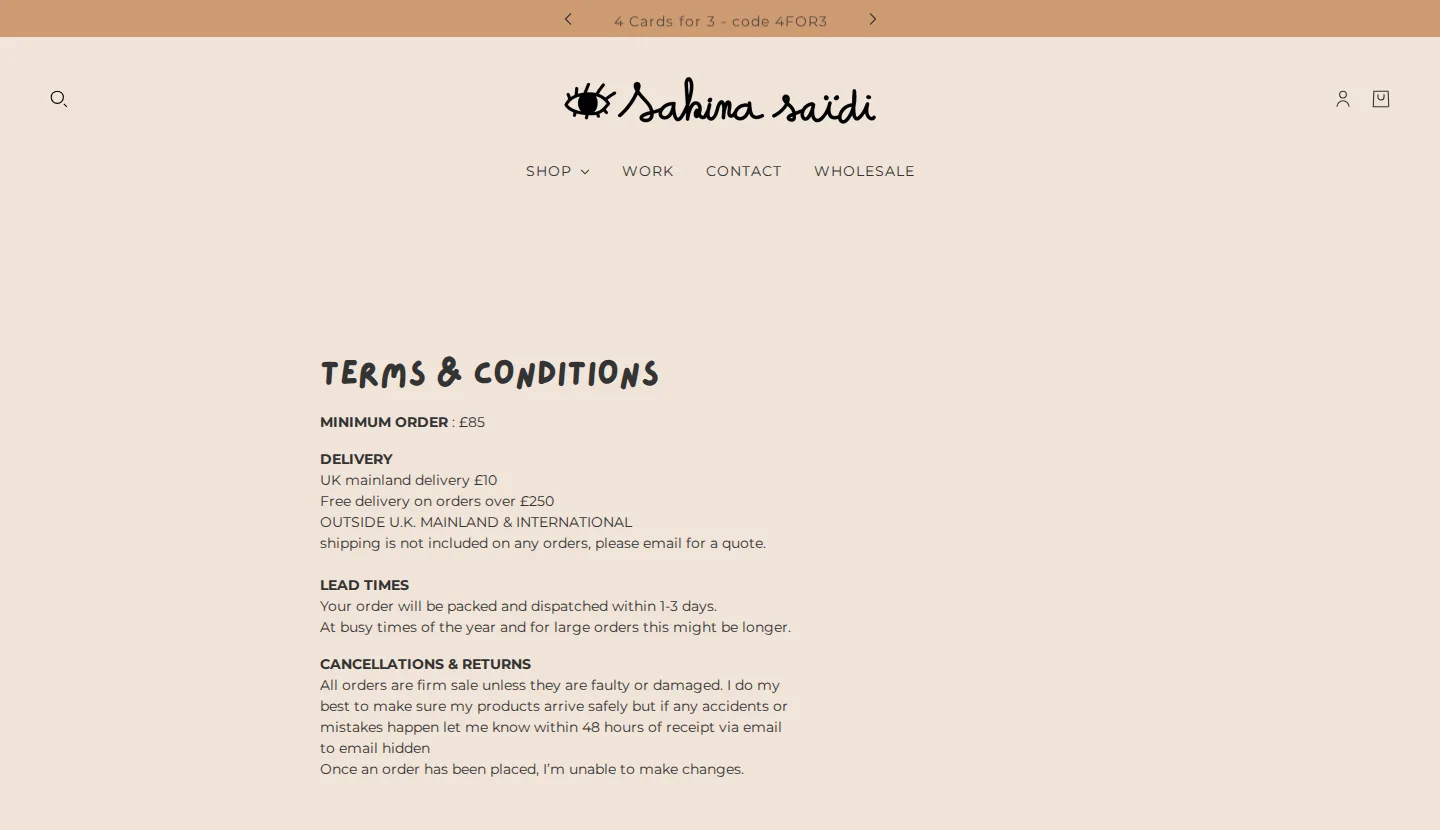
Publishing these terms has two benefits. A shop owner knows what a first order should look like before applying. And each term can be enforced by a setting in the store: the minimum order by an order limit rule, the delivery charges by shipping rates, and sales in packs by quantity increments, so the store can enforce what the page promises.
The stockist journey in five steps
Putting the public pages and the production configuration together, the journey for a new shop looks like this:
- The shop owner finds the Wholesale link in the menu and opens the landing page.
- They fill in the five-field form with the shop name, email, location and website.
- The studio reviews the application and approves it in the app, which adds the customer tag.
- The shop owner logs in and sees the wholesale rules that apply to the tag: prices, pack multiples and the minimum order.
- If the shop owner prefers to email a list, the studio can key it in as a manual order, which uses the same rules and can be sent as an invoice.
Nothing in that list needs a developer after setup, and each step is a screen or a rule the studio can change on its own. That is the real value for a one-person business: the wholesale program does not add a daily task, it adds a routine.
Retail and wholesale on the same product
The retail product page is unchanged for consumers: a price per card, a quantity box and delivery rates. A stockist sees the same products with wholesale rules applied. The product page below is what any visitor sees, which is why the store can run both programs from one catalogue.
Which BSS features power it
Production data for the shop lists which parts of BSS B2B Solution are switched on. The table gives categories only, with no counts of orders, customers or revenue.
| Experience | BSS B2B Solution feature | Evidence |
|---|---|---|
| Short stockist application | Registration form with approval and an automatic tag | Public page /pages/wholesale-signup-form; an active form with a tag on approval in production data |
| Wholesale prices for approved shops | Custom pricing for customer tags | Active custom pricing rules for customer tags, on collections and on selected products |
| Minimum order of a fixed amount | Order limits (minimum order amount) | A minimum order amount rule is switched on, consistent with the published minimum |
| Ordering cards in packs or multiples | Quantity increments | Active quantity increment rules for customer tags, some with minimums |
| Delivery charges that depend on the order | Shipping rate rule for tagged customers | A shipping rate rule for customer tags is switched on |
| Price break for named accounts | Volume pricing for specific customers | A volume pricing rule for specific customers is switched on |
| Orders keyed in on a stockist’s behalf | Manual orders | Manual (draft) orders exist in production data |
To build the same setup, read Wholesale registration form with approval for the form, Enforce minimum order quantity and value for the minimum, and Sell in case packs and multiples for packs. Place orders on behalf of customers covers the manual order flow, which many small brands use when a stockist emails a list. The user guide has pages on quantity increments and manual orders.
Three settings a small brand needs
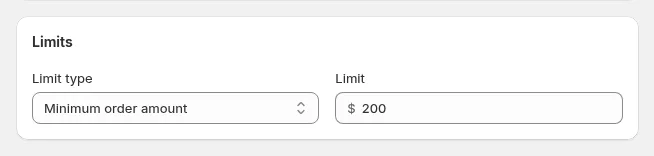
These screens are documentation examples, not heyimsakina’s admin. The first is the order limit that enforces a minimum order amount. The value shown is an example.
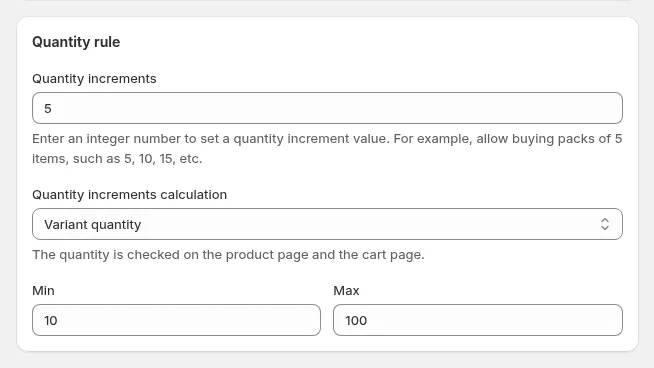
The second is a quantity increment rule. It forces buyers to order in multiples, with a minimum and a maximum, which suits cards sold in packs.
The third is the tag a registration form assigns when an application is approved. One tag per group of stockists is the simplest way to attach prices, minimums and shipping to the right buyers.

What other merchants can copy
- Keep the form to what you need. Five fields are enough when you check a shop’s website yourself. Add tax IDs or documents when your product or region needs them.
- Write the terms like a short letter. Minimum, delivery, lead time and returns in one block, in the voice of your brand.
- Let rules enforce the terms. A published minimum that the store does not enforce creates small arguments. A rule removes them.
- Sell packs, not singles. Quantity increments keep wholesale orders in the size you pack and ship.
- Tag the stockists. One tag lets prices, minimums and shipping follow the same customer.
- Keep a manual order route. Some shop owners prefer to email a list. Manual orders let you key it in with their prices and send an invoice.
- Use brand signals. Independent, printed locally, eco friendly: short badges on the application page speak to the right buyer.
heyimsakina’s review on the Shopify App Store
heyimsakina left a 5-star review of BSS B2B Solution on February 26, 2025, after 14 days of using the app. It is public on the app listing’s review page. The full text:
I had a great experience with BSS B2B Wholesale Solution, thanks to the excellent support from Jonas. He was incredibly helpful and went the extra mile to find solutions that fit my needs. His responsiveness and dedication made the process much smoother, and I truly appreciate his efforts. Highly recommend!
heyimsakina, United Kingdom, review of BSS B2B Wholesale Pricing (BSS B2B Solution) on the Shopify App Store, February 26, 2025, 5 stars
A two-week-old review is an honest snapshot of the setup stage, where support matters most. The merchant credits the support engineer with finding solutions that fit the shop’s needs, which for a one-person brand means rules that match how the owner already packs and ships.
FAQ: wholesale for a small independent brand
How long should a stockist application form be?
As short as your checking process allows. heyimsakina asks for five fields, which suits a small brand that can check a shop’s website by hand. If you need to verify businesses automatically, add a tax ID field, which the app can validate live for EU and UK VAT, US EIN, Australian ABN and India GST numbers.
Can I enforce a minimum order of a fixed amount?
Yes. An order limit rule can set a minimum order amount, and a separate rule type sets a minimum quantity. The limits apply to the cart and to the customers and products you target with the rule.
Can I make buyers order in packs of 6 or 12?
Yes. Quantity increments require multiples of a set number, with an optional minimum and maximum. Increments are available on the Advanced plan and above, and apply on the product page and in the cart.
What if a stockist emails me an order instead of using the site?
Create a manual order in the app. It uses the customer’s rules, so wholesale prices apply, and it can be sent as an invoice or marked as paid.
Do I need a separate store for wholesale?
No. heyimsakina uses one catalogue. Customer tags decide who sees wholesale prices and which minimums and shipping rules apply.
This store spotlight is based on heyimsakina’s public website and its public review on the Shopify App Store, as of October 5, 2026. Screenshots show the public storefront. Admin screenshots are examples of BSS B2B Solution settings from the product documentation. heyimsakina has not reviewed this page.
Install BSS B2B Solution to add a stockist form, minimum orders and pack rules. It is free on development stores, and paid plans have a 14-day trial.
Install BSS B2B Solution See the app