


Uprising Glassware is a Tasmanian drinkware brand that sells 3D-sculpted Australian landmarks and wildlife in borosilicate glass. It runs retail and wholesale on one Shopify store: stockists apply through a form, and the catalogue and wholesale pricing appear after approval, set up with BSS B2B Solution.
About Uprising Glassware
Uprising Glassware (uprisingglassware.com.au) makes drinking glasses with a sculpture pressed into the base. Each glass carries a 3D Australian landmark or animal, from a green sea turtle and a humpback whale to a platypus and a saltwater crocodile, and each comes with an illustrated cork coaster and a travel-safe gift tube. The glass is borosilicate, the same material as Pyrex, and the range includes stemless glasses, old fashioned glasses, wine glasses and a highball.
The brand started in Tasmania, with the first glass inspired by the island’s wilderness, and has grown into collections for Tasmania, New South Wales and Victoria, with a wildlife collection added in 2026. It is a certified member of 1% for the Planet, and says so on its wholesale page next to the products. The site also has a retail locator page, which tells shoppers where to buy in person.
Retail shoppers buy from the store directly: a stemless glass lists at a public price in Australian dollars, with free shipping above a threshold and a build-your-own-set offer. That retail storefront is the shop window. The wholesale program sits next to it, in the same Shopify store.
The B2B model: a hybrid store with an application step
Uprising Glassware sells to two audiences from one catalogue. Consumers buy at retail. Businesses apply to become stockists and, once approved, get a catalogue and wholesale pricing. The wholesale page says so directly: full catalogue and wholesale pricing are available once your account is approved.
The page also tells a buyer whether they fit before they apply. It names four types of retailer: tourism and cultural retail such as national parks, visitor centres, museums and zoos; gift and lifestyle retail such as boutiques, homeware and design stores; food, wine and hospitality such as cellar doors, breweries and providores; and accommodation such as boutique hotels and eco-retreats. The line it uses is that the glass is built for retailers where stories sell.
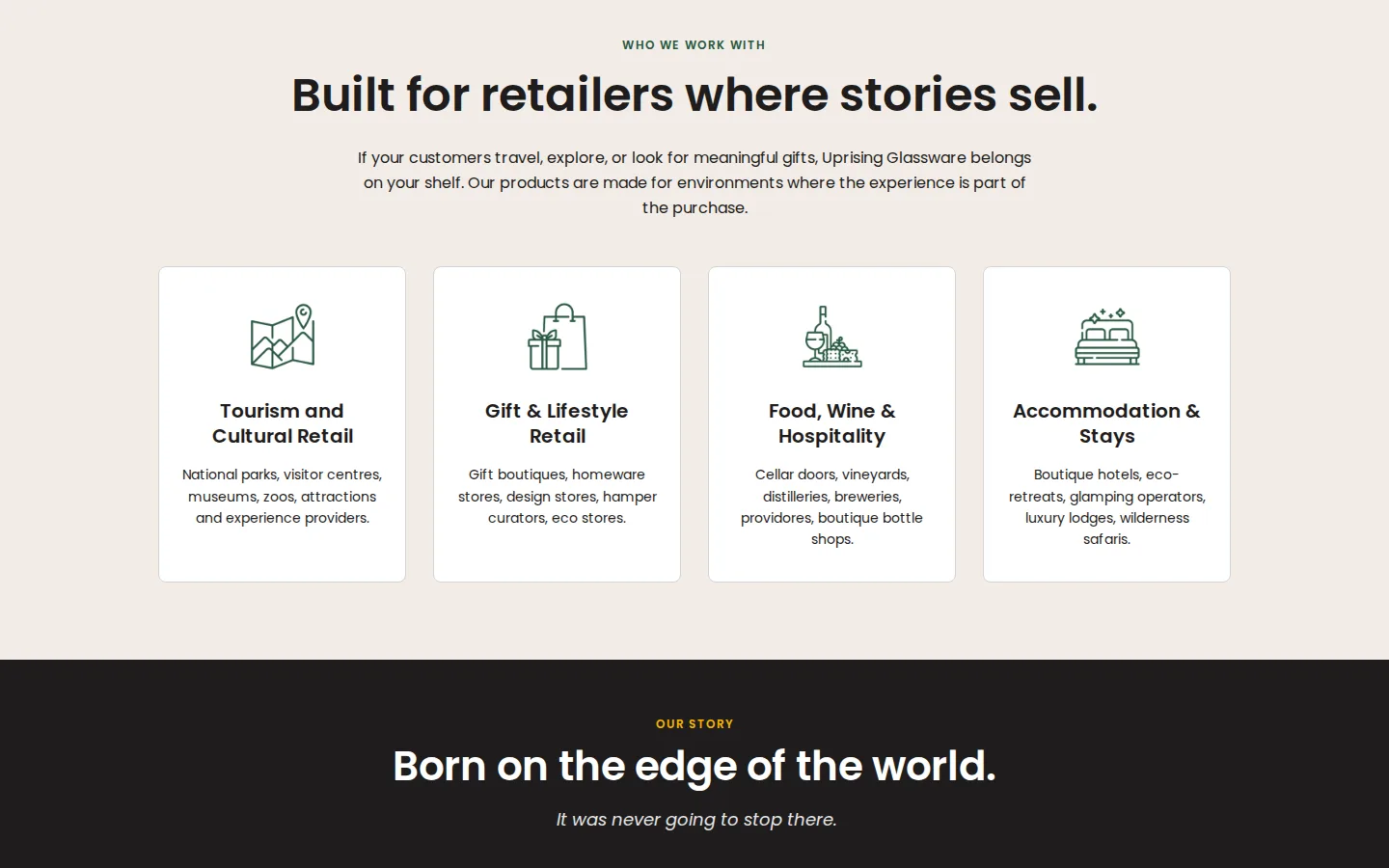
This is the model many small brands use: a public brand story, a stockist page that explains the terms, and an application that gates the price list. It avoids two common problems at once. Retailers are not asked to email for a wholesale catalogue, and the price list never sits on the public site where consumers and competitors can read it.
How the storefront handles wholesale
Terms first, then the application
The wholesale page has a Wholesale Terms and Pricing section with the title Clear terms. No surprises. A table lists eight items. The opening order has no minimum order quantity, and a free display kit is included on opening orders above a stated amount. A sell-through guarantee lets a stockist exchange any SKU that has sold less than a fifth in the first sixty days. Reorders have no minimum quantity either. Payment is taken before dispatch by card or bank transfer, with credit terms available where necessary, for example for government run stores. Dispatch is same day for orders before noon, shipping is partly subsidised, and damaged goods are credited.
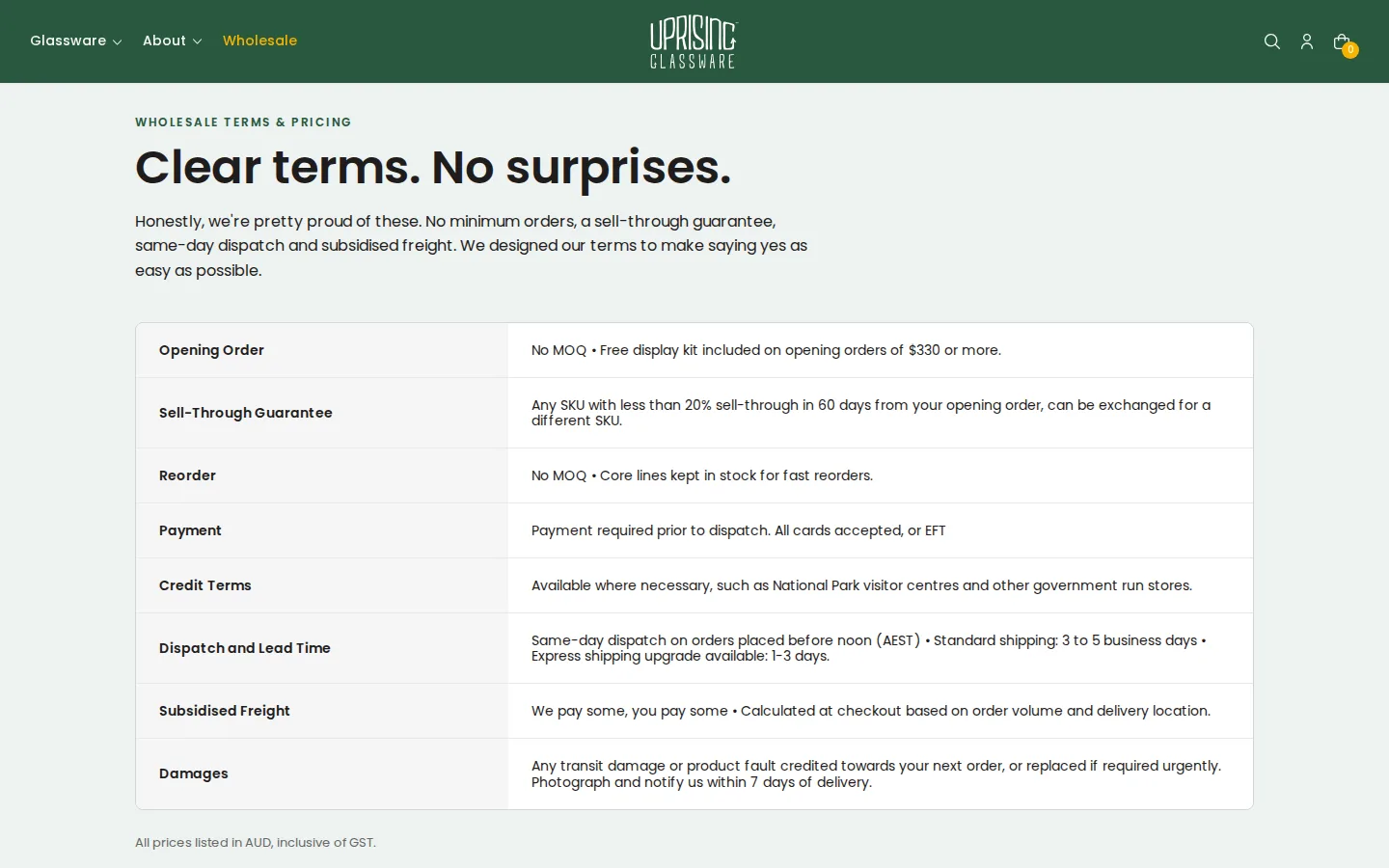
Putting terms in a table has a practical effect. Every row is a question a retailer would otherwise send by email, and every row is also a promise you need your store to keep. Uprising Glassware’s terms match features in the app: a minimum order quantity of none, payment terms for selected accounts, and a shipping charge that depends on the order.
The wholesale application form
The page ends with a four-step Getting Started section: submit an application, receive a welcome pack, place an opening order and merchandise for self-selling. It promises that applications are reviewed within two business days and that approved stockists receive the full catalogue and an account login for online ordering at wholesale pricing. Prices are listed in Australian dollars including GST. The Apply To Become A Wholesaler button jumps to an application form on the same page, and the form also has its own page. It is a BSS B2B Solution registration form titled Wholesale Application Form. It begins with Business Information: company name, ABN, business phone number, business type and a website or Instagram link. It continues with a Primary Contact block: first name, last name, email and phone with a country code.
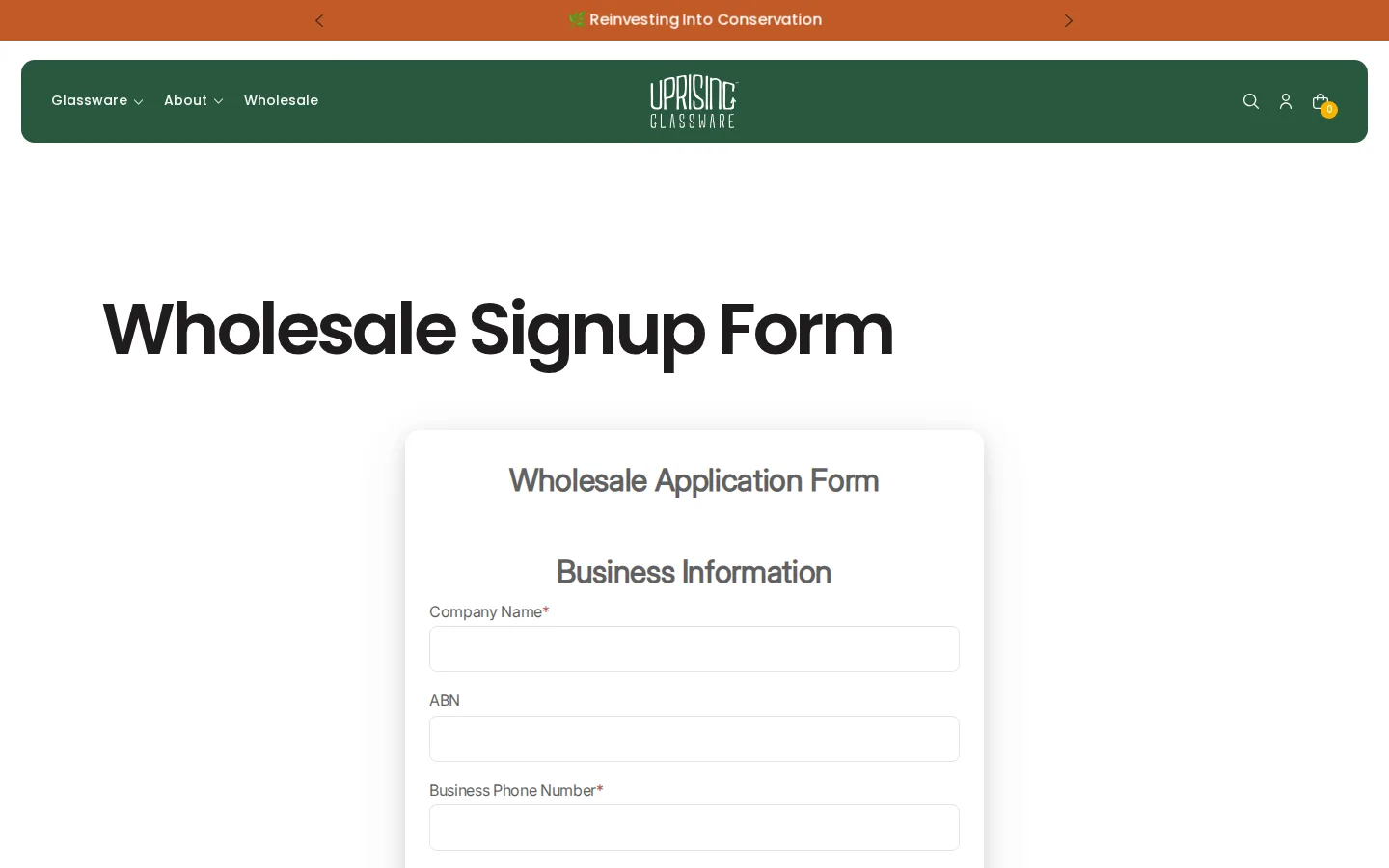
The ABN field is worth noting for Australian stores. The app can validate an Australian Business Number live as the applicant types, so a typing mistake shows up before the form is submitted. Production data shows the form is active and assigns a customer tag when an application is approved.
What an approved stockist sees
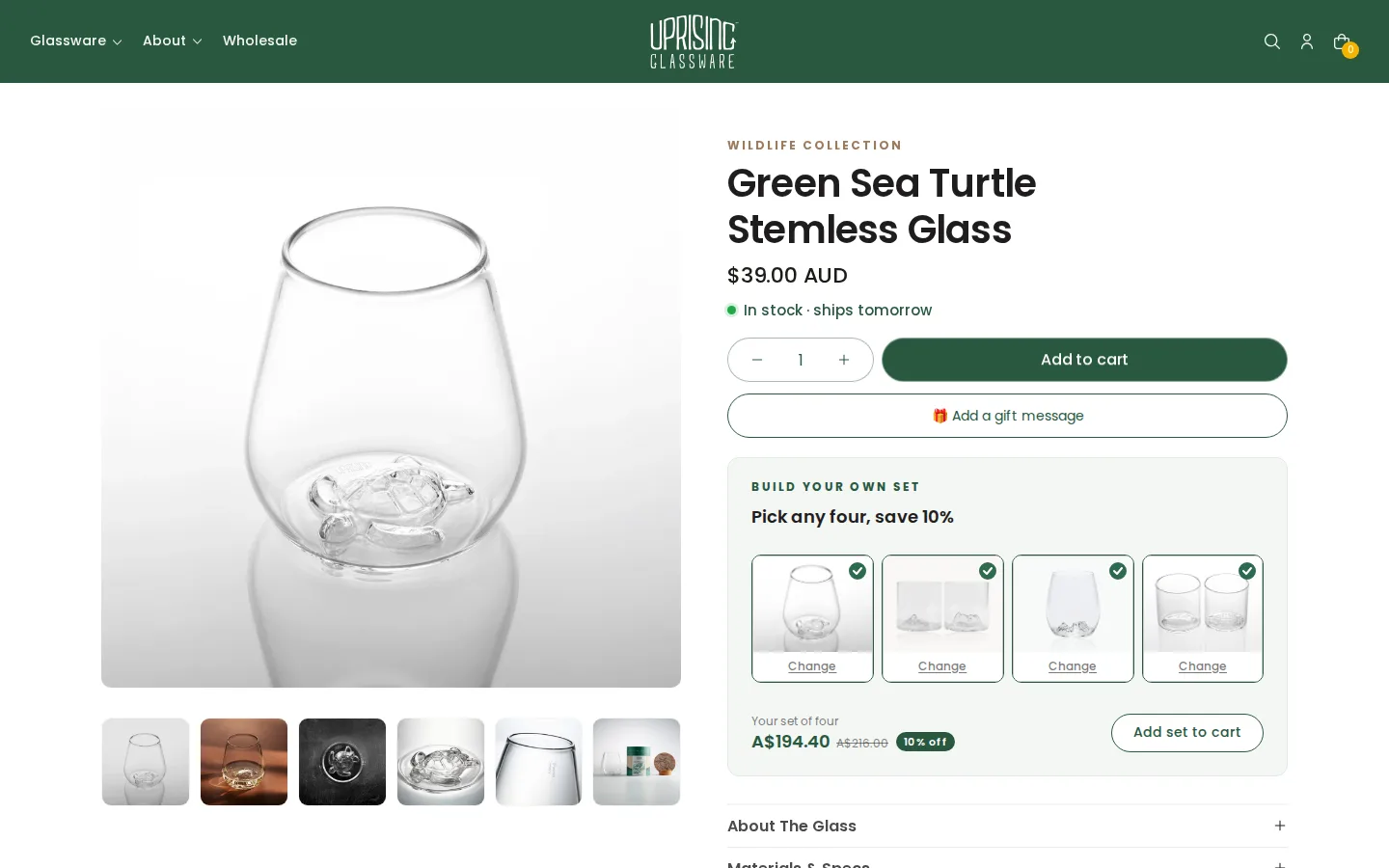
The page also lists partner resources for approved stockists: a digital asset library, a listing on the brand’s retail locator, merchandising guidance for gift, gallery, cellar door and hospitality settings, early access to new releases, and a direct line to a real person on the team. Those resources sit on top of the store settings. After approval, a stockist is a normal Shopify customer carrying a tag. The tag drives everything else. Custom pricing rules that apply to customer tags show wholesale prices, volume tables appear on product pages for tagged buyers, and net terms rules apply to selected customer groups. A guest on the same product page sees the retail price, which is how the product page below looks to a visitor.
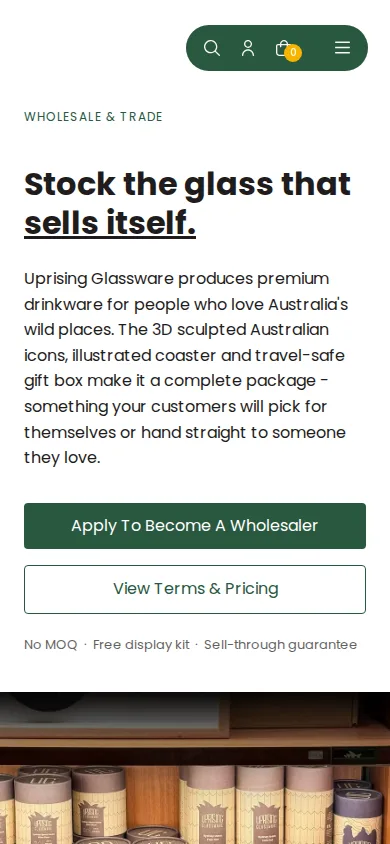
On a phone the same wholesale page stacks into one column, with the terms table and the apply button still reachable by scrolling.
Which BSS features power it
The storefront shows the application and the terms. Production data for the shop shows which parts of BSS B2B Solution are switched on behind them. The table lists feature categories only, never counts of orders, customers or revenue.
| Buyer experience | BSS B2B Solution feature | Evidence |
|---|---|---|
| Apply as a stockist with ABN and business details | Registration form with approval and an automatic tag | Public page /pages/wholesale-signup-form; an active form that assigns a tag in production data |
| Wholesale prices after approval | Custom pricing for customer tags and for specific customers | Active custom pricing rules for customer tags in production data |
| Price breaks on quantity | Volume pricing tables for tagged and named customers | Active volume rules, and the table component on product pages |
| Credit terms where necessary | Net terms rules for customer groups | Several net terms rules for tagged and specific customers are switched on |
| Subsidised freight that depends on the order | Shipping rate rule | A shipping rate rule for specific customers is switched on |
| Customers tagged automatically | Auto tags | Active auto tag rules in production data |
| Buy one get one offers and manual orders | BOGO rules, manual orders | Both modules have active records in production data |
The review below says the team built a few custom features for the store. We do not describe them here because they are not visible on the public storefront. What can be said is that the rules above give a small brand a complete wholesale setup without a separate B2B storefront. If you want to copy the setup, start with Wholesale registration form with approval, then Offer Net 30 and other payment terms to wholesale buyers and Show a volume pricing table on product pages. The user guide covers net terms and registration forms.
Three screens you will use
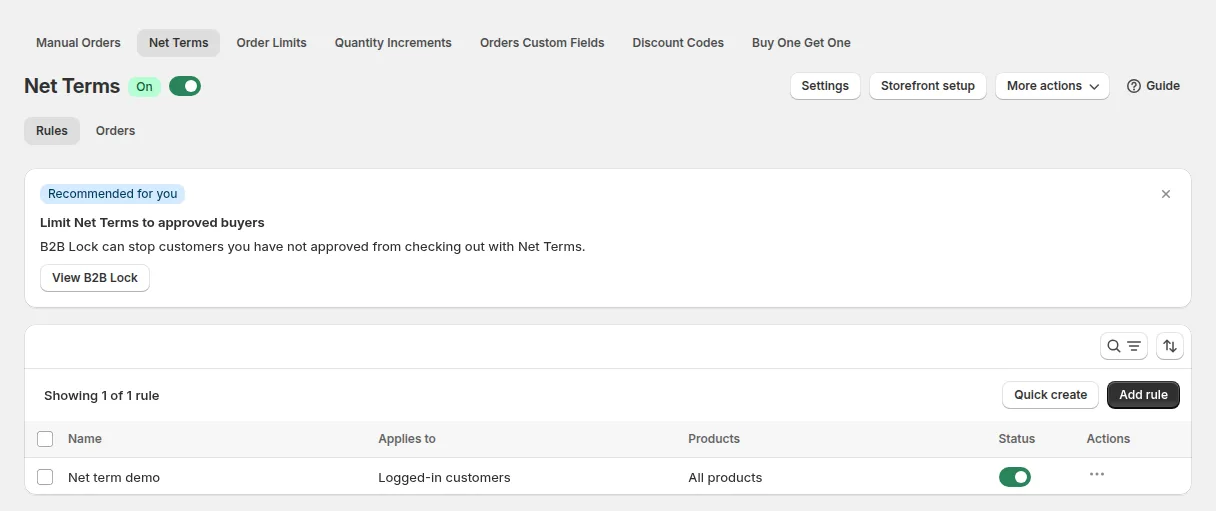
The next images show where the settings live. They are documentation examples, not Uprising Glassware’s admin. Net terms are set as rules for customer groups, which is how a store can offer credit to a visitor centre and cash on dispatch to everyone else.
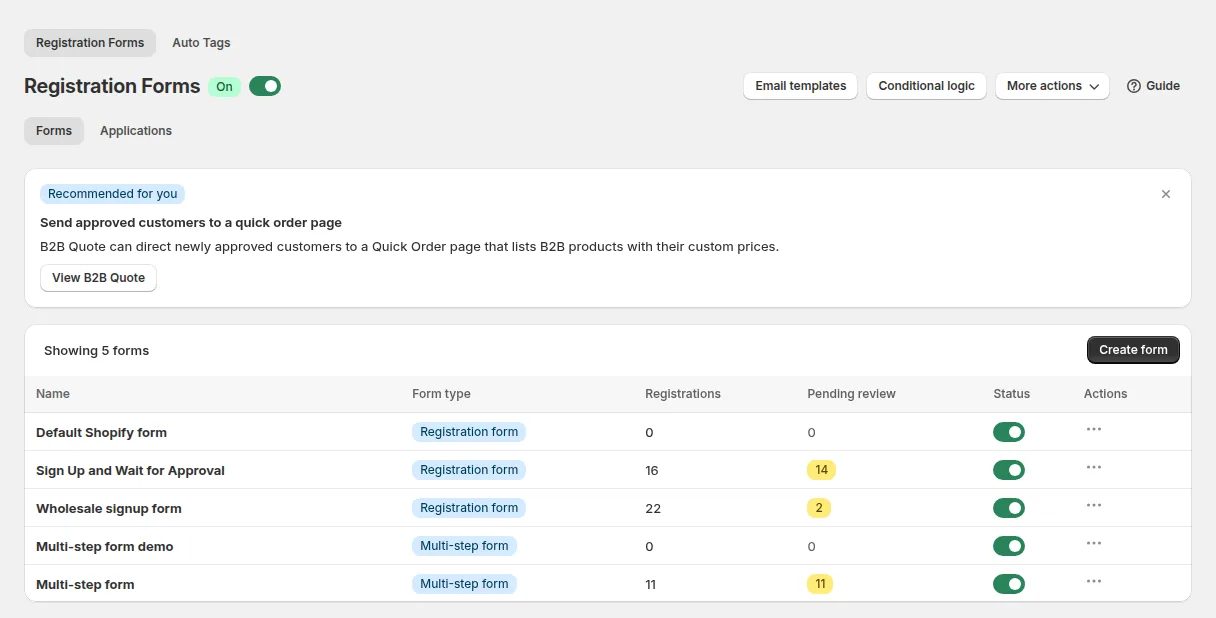
Registration forms have their own list, with a count of pending reviews. This is the screen a small team opens each morning to approve or reject new stockists.
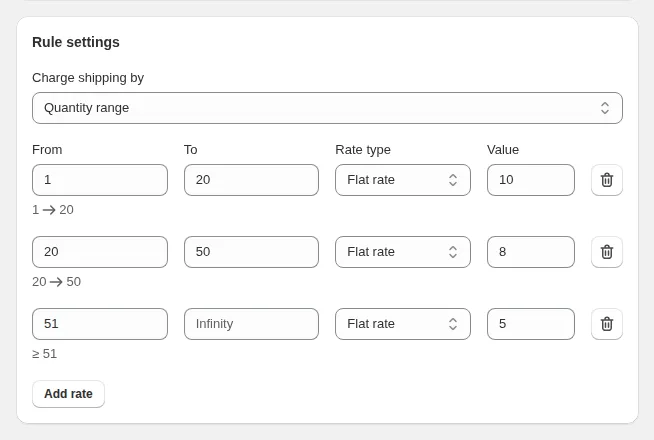
A shipping rate rule can charge by quantity range, which suits a promise such as a freight contribution that depends on order size.
What other merchants can copy
- Publish your terms in a table. Minimum order, guarantee, payment, dispatch and damages answers fit in eight rows and cut the first round of emails.
- Name your ideal retailer. Four short categories help a buyer decide to apply, and help you decline the wrong ones.
- Gate the catalogue, not the story. The brand story, collections and terms are public. Pricing and the full catalogue wait for approval.
- Collect the tax ID at the door. An ABN, VAT number or EIN field lets you check the business before you approve.
- Use tags for price groups. One tag per group lets custom pricing, volume tables and net terms follow the same customer.
- Offer credit only where it is needed. A line such as credit terms where necessary keeps cash up front the default and makes exceptions a rule you can set.
- Keep retail and wholesale in one store. One catalogue and one set of product pages is easier to keep correct than two storefronts.
Uprising Glassware’s review on the Shopify App Store
Uprising Glassware left a 5-star review of BSS B2B Solution on February 3, 2026, after 25 days of using the app. It is public on the app listing’s review page. The full text:
Absolutely outstanding customer support and help with any request we’ve made so far. We required a few custom features for our store, and the team at BSB B2B has gone above and beyond to ensure our store works exactly as needed with their app. The app itself is packed with B2B features, and the value from these features and the support make it well worth it!
Uprising Glassware, Australia, review of BSS B2B Wholesale Pricing (BSS B2B Solution) on the Shopify App Store, February 3, 2026, 5 stars
Support and custom work are the theme. The merchant also says the app is packed with B2B features, which matches the range visible in production: forms, pricing, tables, terms, shipping rules and tagging in one app.
FAQ: wholesale for a small brand on Shopify
Can I show wholesale prices only to approved retailers?
Yes. Approved applicants receive a customer tag, and custom pricing rules that apply to that tag show them wholesale prices. Guests see retail prices. If you also want prices hidden from guests, BSS B2B Lock does that as a separate step.
Does the app validate an Australian ABN?
The registration form can include a tax ID field that checks an Australian Business Number as the applicant types. It also supports EU and UK VAT numbers, US EINs and India GST numbers. The check runs in the browser at entry and does not replace your own review of the application.
Can I offer credit terms to some stockists only?
Yes. Net terms are rules, so you can apply them to a customer tag or to specific customers and leave everyone else on payment before dispatch. The user guide explains the rule settings.
Can stockists order in cartons or other multiples?
Yes. Quantity increments let you require multiples of a set number, for example full cartons, and set a minimum and maximum. Quantity increments are available on the Advanced plan and above. See the use case on selling in case packs and multiples.
Do I need a separate store for wholesale?
No. Many brands, including Uprising Glassware, run retail and wholesale from one store. Tags separate the two experiences, so a retailer sees wholesale prices and a consumer sees retail prices on the same product page.
This store spotlight is based on Uprising Glassware’s public website and its public review on the Shopify App Store, as of October 5, 2026. Screenshots show the public storefront. Admin screenshots are examples of BSS B2B Solution settings from the product documentation. Uprising Glassware has not reviewed this page.
Install BSS B2B Solution to add an application form, tag based prices and net terms. It is free on development stores, and paid plans have a 14-day trial.
Install BSS B2B Solution See the app