

Wild Boar Bike Racks, a family business in Torquay, Victoria that designs and makes bike racks for caravans and cars, sells direct and through dealers. Resellers apply on a Become a Reseller form with an ABN, then get quantity breaks and account-specific prices from BSS B2B Solution.
About Wild Boar Bike Racks
Wild Boar Bike Racks is a locally owned business on the south-west coast of Victoria. Its about page says the team designs, engineers and supplies the racks itself rather than importing them, and the footer line says it designs, manufactures and sells caravan and car bike racks from Torquay. The founder story on the site begins with a travelling family that could not find a rack durable enough for caravan life, and a design background that led to a rack with two vertical support bars.
The range centers on the Freedom caravan bike rack in drawbar, tool box and direct flush mounts, a motorhome rack and an e-bike car rack, plus accessories such as loading ramps, support bars and light and plate kits. Prices are shown in Australian dollars, with a New Zealand currency option and separate New Zealand product listings. The home page promises a lifetime warranty on the rack, free freight within Australia on orders over $600, support from a real person during business hours, do-it-yourself assembly with video guides, and compatibility with heavy e-bikes.
A rack for a caravan is bought once, but it is sold many times over, at caravan dealers, to caravan manufacturers who fit it at the factory, and by bicycle shops. A store like this has two customers who need different things: a family that wants to buy one rack with confidence, and a business that wants to resell several at a margin.
The B2B model: a maker with a reseller program
Wild Boar sells direct to the public at published prices and runs a wholesale partner program for businesses. The navigation has a Become a Reseller link, and the footer has a Wholesale Enquiries link. The reseller page is titled Welcome to Our Wholesale Partner Program and opens with two tabs. One explains how the program works, with a video from the business, and the other tells how the Freedom bike racks were created. Under the tabs is the application form.
The three business types on the form show who the program is for: caravan dealers, caravan manufacturers and bicycle retail stores. Each of them buys differently. A dealer resells to owners, a manufacturer fits racks into new caravans, and a bike shop sells to cyclists. One form with a business-type question sorts them, and the answer can later decide which price list or quantity table the account receives.
The owner’s public review describes the result in plain terms: a good solution for wholesaling, with many options for wholesale customers. That fits the configuration we can see, which uses several different pricing tools at once rather than one blanket reseller discount.
The public side of the site also works for dealers. A Find Your Rack page helps a buyer choose the right model, a fitting guide and a videos and resources page explain installation, and the home page points to hundreds of Google reviews. A caravan dealer can send a customer to the same fitting guide, which cuts down on pre-sale questions and makes the rack easier to resell. Content like this is part of the reseller offer, even though it sits outside the form.
How the storefront handles wholesale
Public prices for the public
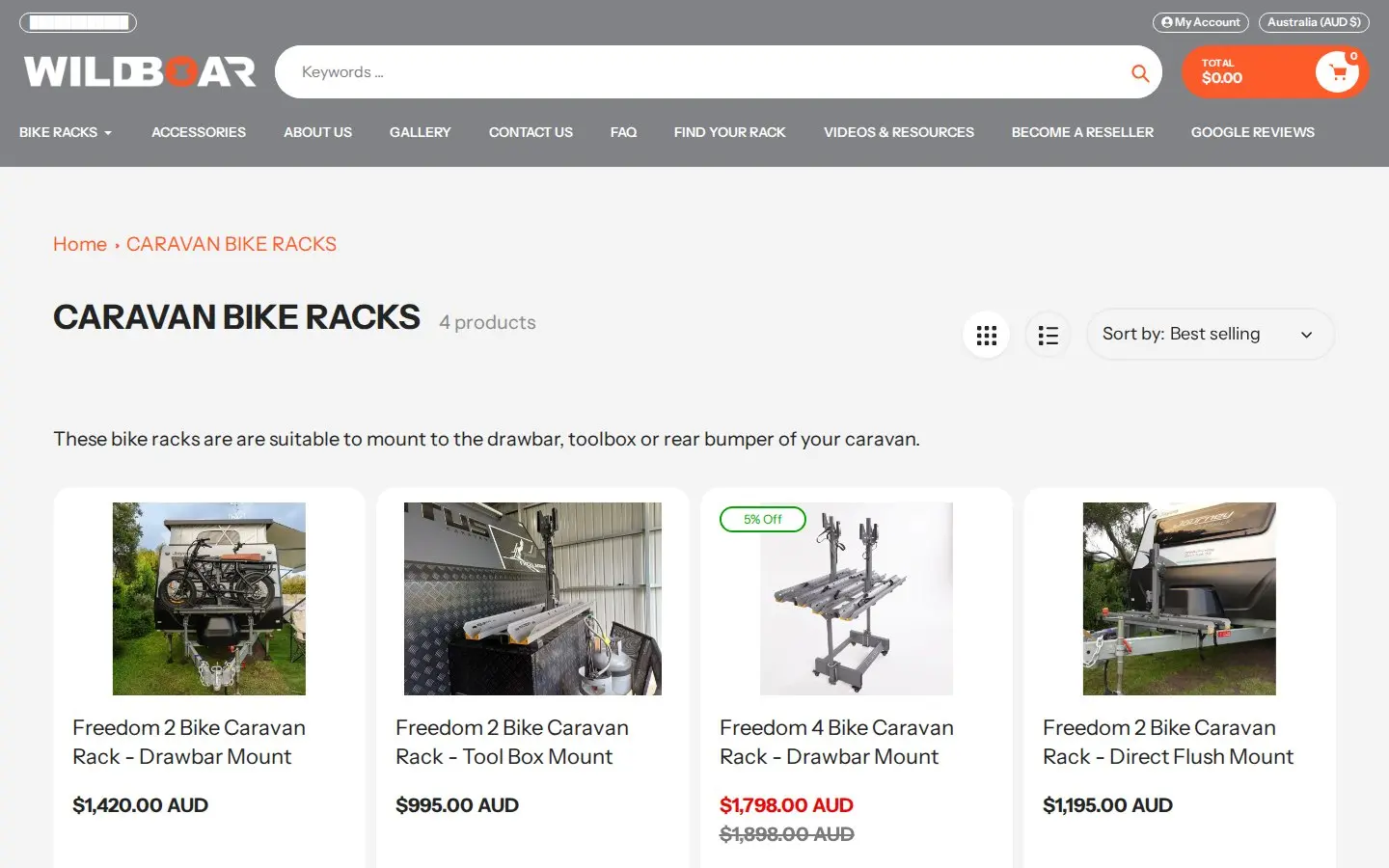
The caravan bike racks collection shows four racks with their prices: $1,420, $995, $1,798 on sale and $1,195 AUD. One has a green percent-off badge. A visitor can compare mounts, read the description and buy. There is nothing to log in for, and the store makes no attempt to hide prices from the public. The retail experience is the foundation, and the reseller program sits beside it.
An application that qualifies the business
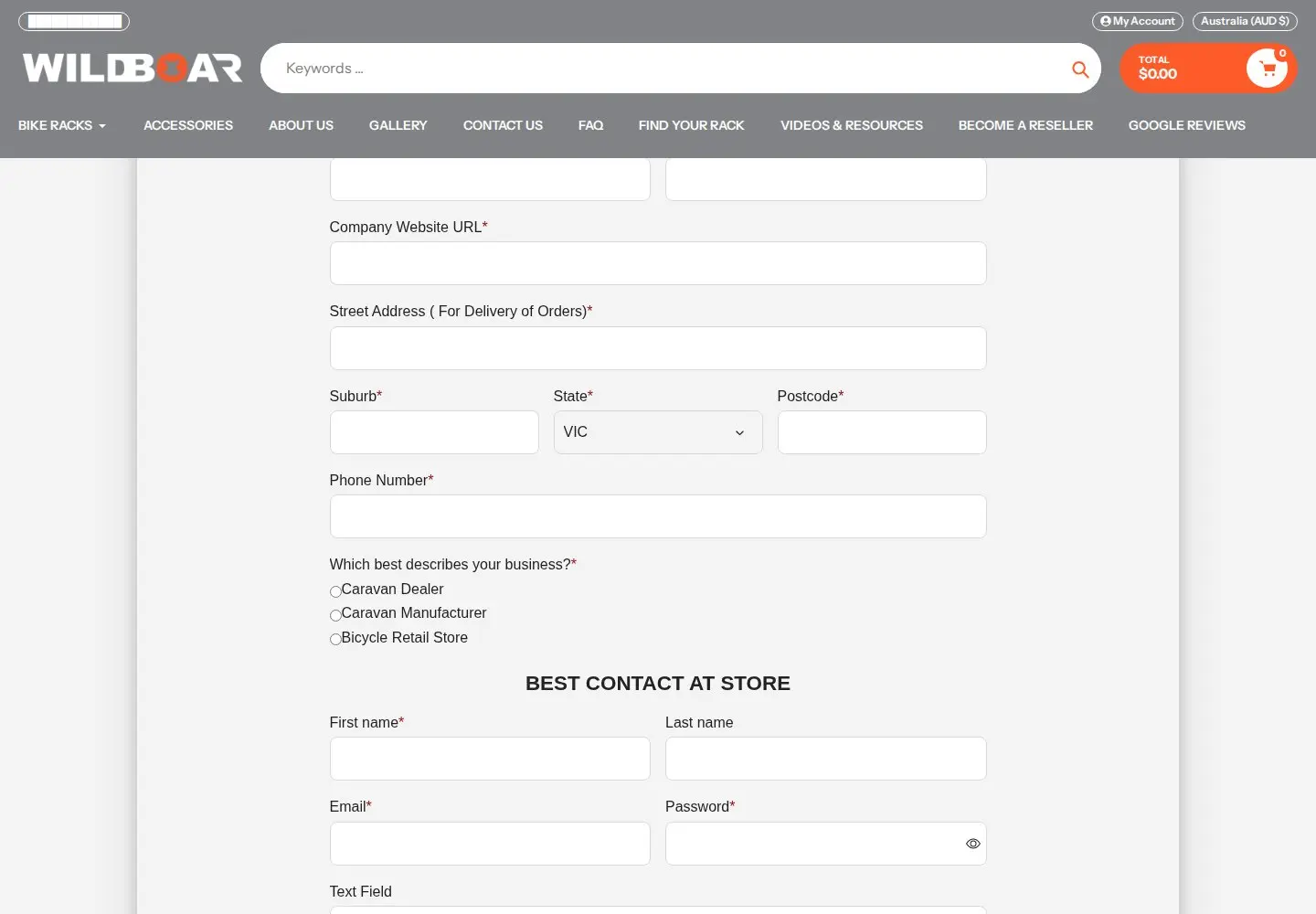
The form is titled Become a Reseller and divides into two parts. Company details ask for company name, ABN, company website URL, street address for delivery of orders, suburb, state, postcode and phone number. The state dropdown lists Victoria, South Australia, Queensland, Western Australia, Tasmania, the Northern Territory, New South Wales, the Australian Capital Territory and New Zealand, so the same form serves both markets. Then comes the question about the type of business, with the three options above. A second part, Best Contact at Store, asks for first name, last name, email and password, plus an optional free text field.
The ABN and website are the qualifiers. An Australian business number lets the team check that the applicant is a registered business, and the website lets them see that it actually sells the product. Asking for both before approval is cheaper than discovering later that an order came from a hobbyist.
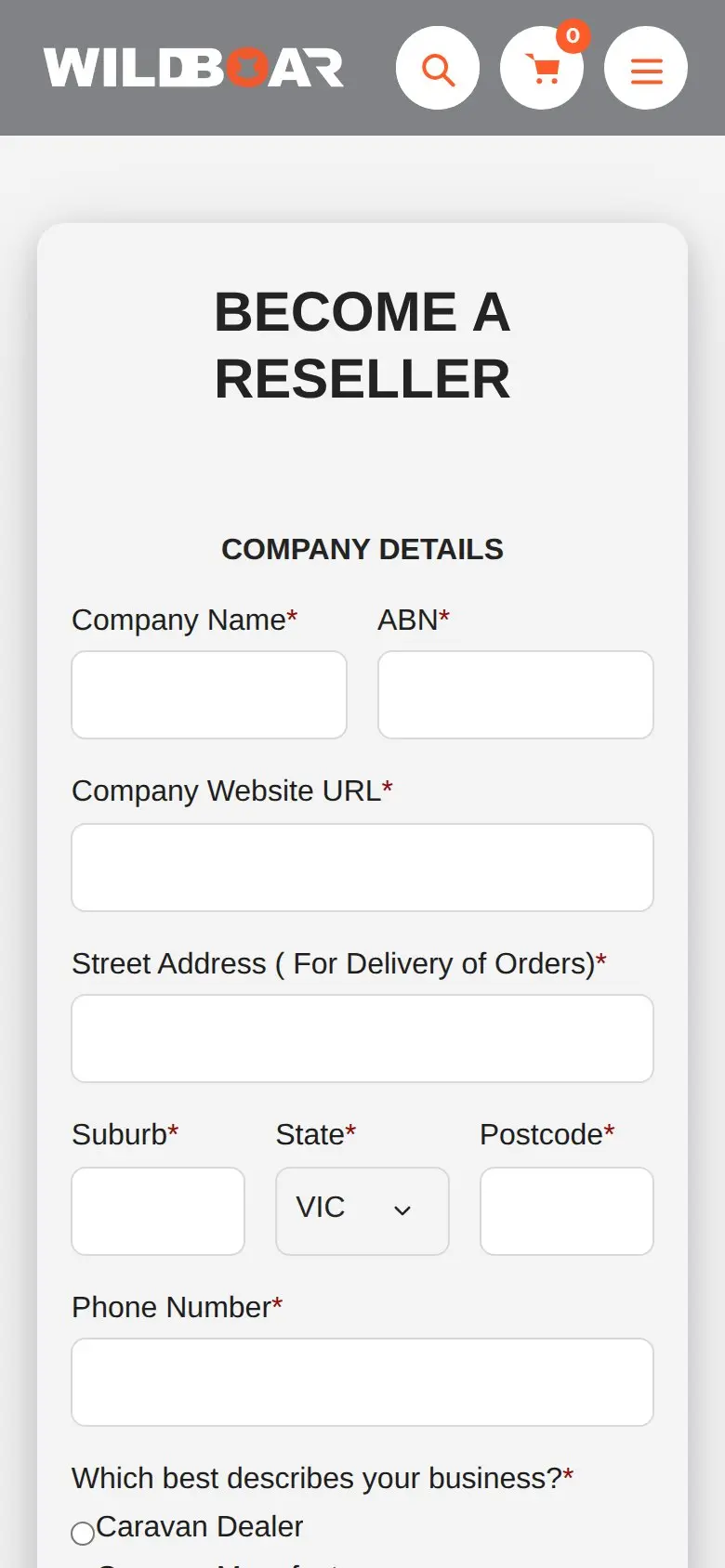
On a phone the form keeps its structure: the section heading, then company name and ABN side by side, and the rest of the fields in a single column below. A dealer who hears about the program in conversation can apply from a phone on the spot.
Which BSS B2B Solution features power it
We compared the storefront with the app’s production configuration: a read-only check of which modules have active rules, with no customer or order data. Prices and discount values are not published here.
| Feature | What we found | Learn more |
|---|---|---|
| Registration form | A live Become a Reseller form built with the BSS form, with business type and ABN questions | Registration form with approval |
| Custom pricing | Active rules for specific customers and for customer tags, both covering all products | Personalized wholesale pricing |
| Price list | Active price lists for specific customers, set at product level | Price list per buyer group |
| Volume pricing | Active rules: a multi-tier table for tagged customers and a separate table for specific customers | Quantity breaks |
| Order limits | A minimum order amount rule for specific customers | Minimum order quantity and value |
| Discount code | An active code rule for specific customers | Discount codes |
Two ways to price a reseller
The setup shows two separate models side by side. Tag rules treat resellers as a group: a tagged reseller gets the group’s custom pricing and the group’s quantity table, so larger orders earn a lower price per rack. Specific-customer rules treat resellers as accounts: price lists, an order minimum and a code are aimed at named customers. That is the pattern for a large dealer or an OEM partner with negotiated terms, while the group rules cover the rest.
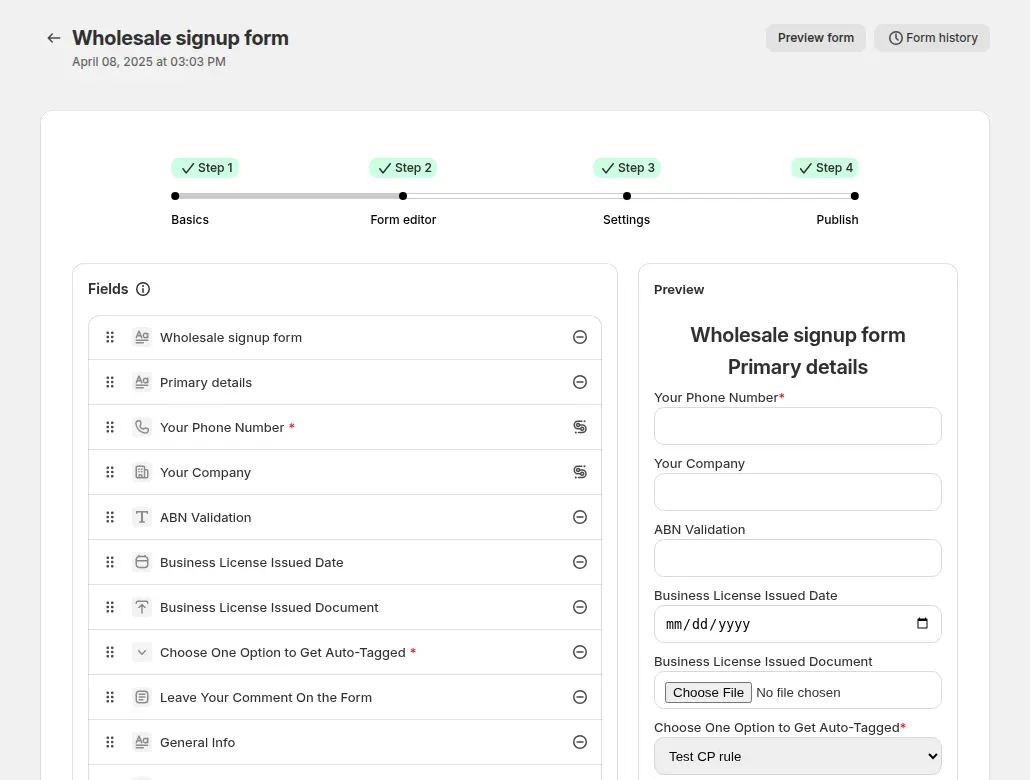
The registration form is built in the app’s editor. The guide’s example includes an ABN field. BSS offers an ABN validation field type that checks the number against the Australian business register as the buyer types, and it blocks submission only when the field is required. Whether Wild Boar uses it is not visible from outside; the use case on verifying a business tax ID shows the setup.
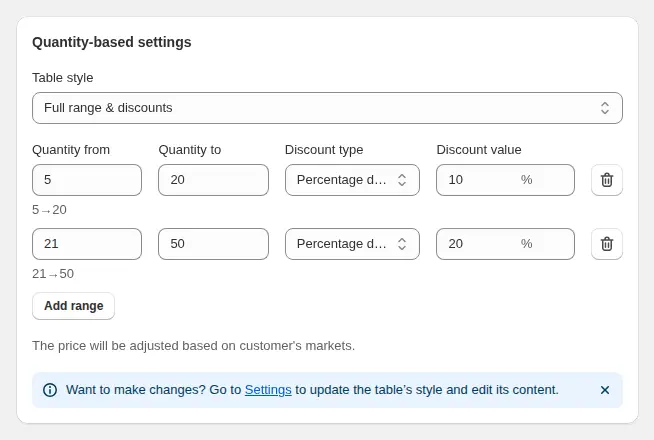
A quantity break table lists ranges, each with a discount type and value. Wild Boar has one table for tagged resellers and a separate one for named accounts, each with several tiers. The volume pricing table use case shows how the table appears to the buyer on a product page, and the tiered pricing guide explains the settings.
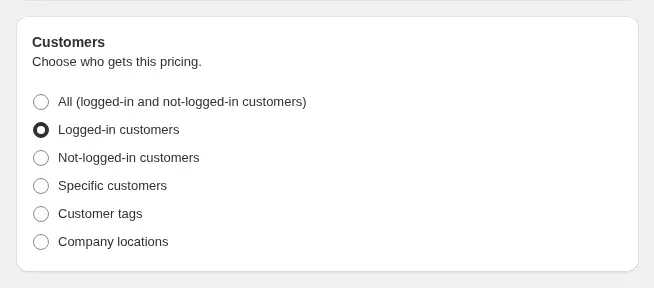
A price list lets you set a specific price per product for a customer or tag, which is the tool for “this dealer pays this much for this rack”. The price list guide covers the table of products and prices. Price lists and custom pricing rules interact by priority: when both apply to the same variant, the price list wins, and volume discounts then stack on top of that price.
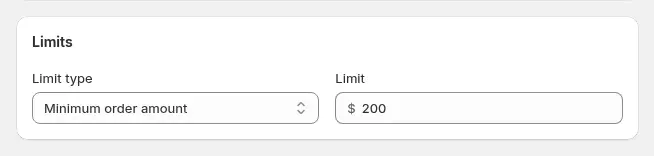
The minimum order amount protects margin on small orders. For a maker that ships heavy racks by freight, a reseller order below a certain value costs as much to pack as a large one.
What other merchants can copy
- Ask the business type in the form. A radio question that sorts applicants into dealers, manufacturers and shops gives you a basis for which pricing they receive.
- Collect a registration number you can verify. ABN, VAT, EIN or GST fields let you confirm the applicant before approving.
- Ask for a website. It tells you in seconds whether the applicant sells what you make.
- Use groups for most resellers and accounts for the big ones. Tags with a quantity table cover the long tail, named price lists cover the few negotiated deals.
- Make one form serve more than one market. A state dropdown that includes New Zealand avoids a second form.
- Explain the program before the form. A short video or a two-tab explainer lets a reseller decide whether to apply.
- Set a minimum order amount for resellers. Pick a number from your own freight and packing costs.
Wild Boar Bike Racks’ review
Wild Boar Bike Racks left a public review of BSS B2B Solution on the Shopify App Store: 5 out of 5 stars, last edited July 29, 2026, after about two years of use. The review, quoted verbatim apart from a sentence that names a support person:
"great solution for wholesaling. Many options to provide to wholesale customers and great support from the App providers. Its now 2026 and they helped my out again with a tech issue. […]"
Wild Boar Bike Racks, public review on the BSS B2B Solution listing, 5 stars, edited July 29, 2026
The detail worth noting is the time frame. The store has used the app for about two years and went back for help in 2026. Wholesale setups change as a business adds markets and products, and a long-running store is a better judge of whether the options and support hold up than a new install.
FAQ
Can a manufacturer run a reseller program next to its public Shopify store?
Yes. Keep retail prices public, add a reseller registration form, and use customer tags and customer-specific rules to give approved resellers their own pricing. See the use case on selling B2B and B2C from one store.
How do I give one big dealer a different price from other resellers?
Use a price list or custom pricing rule aimed at that customer, and keep a tag-based rule for the rest. When rules overlap, priority numbers decide which one wins.
Can quantity discounts apply only to approved resellers?
Yes. A volume pricing rule can target logged-in customers, specific customers or customer tags, so retail buyers do not see reseller breaks.
Can one registration form serve Australia and New Zealand?
Yes, if the form’s state or country field lists both. Wild Boar’s dropdown includes New Zealand. For separate currencies or catalogs per market, see wholesale prices per market.
How do I check that an applicant is a real business?
Ask for a registration number and a website, and use a tax ID field with live validation if your country is supported. Review applications before approving them.
This store spotlight is based on Wild Boar Bike Racks’ public website and its public review on the Shopify App Store, as of October 5, 2026. Screenshots show the public storefront with the phone number masked. Admin screenshots are labelled examples from the BSS user guide, and the descriptions of active features come from a read-only check of feature configuration.